

In 2026, financial advisors are running more complex businesses. Teams are larger. Client expectations are higher. Service models are layered.
Data lives across the tech stack: planning tools, custodians, marketing platforms, and reporting systems.
Suddenly, your CRM isn’t just a contact database anymore.
It’s the workspace your entire firm runs on. That shift has changed how advisors evaluate CRM systems. What once worked as a simple tool now has to support practice management, real-time visibility, automation, and client engagement all in one place to be considered the best CRM for a modern firm.
And that’s why more firms are taking a closer look at the Redtail Technology they’ve relied on for years.
Including Redtail…
Why Redtail CRM Worked for So Long
Redtail has been part of the wealth management and financial services industry for decades.
For many firms, it was their first true CRM solution built specifically for financial professionals. It brought structure where there used to be spreadsheets. It centralized contact management and essential contact information. It helped document client interactions and supported compliance workflows that mattered.
For a long time, that was a major upgrade.
Redtail made it easier to track relationships, manage basic task management, and keep a clear history of client activity. Its advisor-focused design set it apart from generic sales CRM platforms built for startups or small businesses.
It also built a large ecosystem around financial services, offering integrations with planning tools like eMoney, portfolio management systems, custodians, and familiar platforms like Microsoft Outlook and Google G-suite. For firms that wanted a cloud-based CRM designed for their industry, Redtail became a trusted choice.
Even today, many advisors appreciate its consistency, dependable customer support, and familiarity across the industry, including tools like Redtail Speak for compliant texting.
Redtail didn’t try to be everything.
It focused on helping firms stay organized.
And for a long time, that focus worked.
Why Financial Advisors Begin to Outgrow Redtail CRM Features
Most firms don’t leave Redtail because something breaks. They leave because their business evolves.
As advisory practices grow, processes become more detailed. Service models expand. Teams add specialized roles. Workflows that once felt sufficient start needing adjustments mid-year, not full rebuilds.
That’s often where friction appears.
Tasks still get completed, but task management can feel more manual than expected. Workflows exist, but adapting them to a firm’s specific needs isn’t always simple. Reporting often requires exporting data just to analyze what’s happening across the business.
Integrations connect systems, but they don’t always feel seamless. Calendar syncs, email logging, and activity tracking sometimes require cleanup. Information lives in the CRM, but it doesn’t always surface when it’s needed most.
Over time, teams start building workarounds.
Spreadsheets supplement dashboards. Manual updates replace automation. Admin work grows as data volume increases.
Nothing is technically broken. It just takes more effort than it should. What once felt structured can begin to feel rigid. What once saved time can start consuming it. That’s usually the moment advisors begin exploring Redtail CRM alternatives.
Not because Redtail stopped working. But because their firm outgrew what organization alone can provide.
Why Look for a Redtail CRM Alternative in 2026
The expectations for CRM software have changed.
In 2026, many advisors aren’t just looking for systems that store information. They want CRM systems that actively help move the business forward. A modern CRM solution needs to do more than record activity. It should streamline and automate workflows, reduce manual effort, and provide real-time insight into what’s happening across the firm.
Financial advisors now expect their CRM to:
- Support flexible workflows that adapt as processes change
- Automate routine tasks instead of creating more of them
- Deliver dashboards that reflect real-time activity
- Connect cleanly with email, calendars, and core tools through reliable APIs
- Support client management, lead management, and lifecycle tracking in one place
- Operate as an all-in-one workspace rather than a collection of disconnected features
This shift has little to do with preference and everything to do with scale.
As firms grow, the cost of manual work increases. Admin time expands. Reporting becomes more complex. Leadership needs clearer visibility. Advisors need systems that help prioritize, not just document.
That’s why many firms begin looking beyond traditional CRM automation and toward platforms that combine customer relationship management, practice management, and execution into a single cloud-based CRM.
Not to replace Redtail overnight.
But to find a system built for how advisory firms operate now.
And that’s where the comparison truly begins.
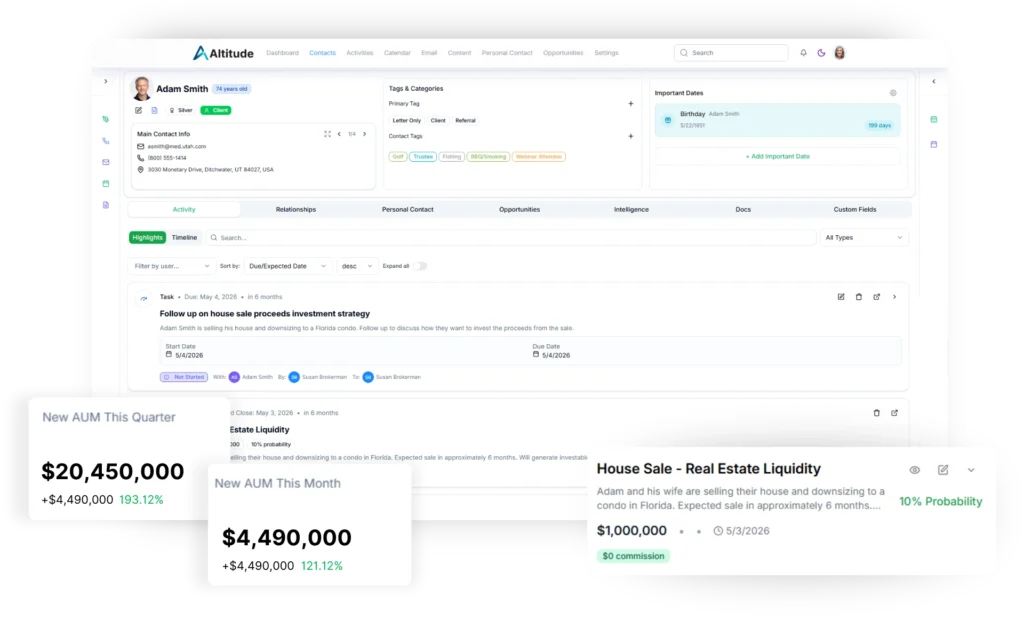
1. Altitude CRM: The Best Redtail Alternative for Financial Advisors in 2026
If Redtail is designed to help firms stay organized, Altitude CRM is designed to help them operate.
Altitude CRM wasn’t created as a generic sales CRM that was later adapted for financial services. It was built from the ground up as an all-in-one platform for financial advisors who need more than contact management and task lists.
Think of the difference between a filing system and an operating system.
One stores information. The other helps everything move.
That’s the role Altitude fills.
Instead of forcing advisors to adapt their workflows to software limitations, Altitude adapts to the way advisory firms actually work. Client data, service processes, team responsibilities, and follow-ups all live inside a unified workspace that’s designed to streamline execution, not just document it.
Where many CRM systems focus on tracking activity, Altitude focuses on helping the right activity happen at the right time.
Why Advisors Choose Altitude CRM Over Redtail CRM
Redtail brings structure. Altitude brings momentum.
That difference becomes more noticeable as firms grow.
With Altitude, workflows aren’t rigid paths that need to be rebuilt when processes change. They’re flexible systems that evolve alongside the business. Advisors can adjust steps, add automation, and update templates without disrupting everything downstream.
Task management moves beyond static reminders. Tasks trigger actions. Notifications surface what matters. Client activity flows forward automatically instead of waiting for manual updates.
Reporting also looks different.
Instead of exporting data to spreadsheets, firms see real-time dashboards that reflect what’s actually happening across the business. Leadership gains visibility without chasing reports. Financial advisors know exactly where clients stand without digging through records.
Integrations feel intentional rather than patched together. Email, calendars, and communication history stay connected through a clean API layer, keeping client management consistent across tools like Microsoft Outlook and Google G-suite.
In short, Altitude doesn’t just organize information.
It helps execute the work tied to it.
Pathfinder AI: Built-In Intelligence That Moves Work Forward
One of the biggest differences between Altitude and traditional CRM automation is its built-in, AI-powered assistant, Pathfinder.
Pathfinder isn’t an add-on. It’s embedded directly into the customer relationship management system and understands the full context of your firm’s data.
That matters.
Because instead of simply summarizing notes or logging activity, Pathfinder helps advisors decide what to do next. It analyzes workflows, client engagement, open tasks, and lifecycle stages to surface meaningful insights in real time. Advisors can instantly see which relationships need attention, which opportunities require follow-up, and where client service momentum may be slowing.
Rather than digging through records, Pathfinder delivers context at the moment it’s needed.
This turns CRM automation into something far more useful than reminders.
It becomes guidance. (Helping you find a way forward, hence PATH-Finder!)
The result is less manual oversight, fewer missed follow-ups, and stronger client engagement across the entire lifecycle.
AI doesn’t replace the advisor.
It supports them by reducing noise and helping prioritize what actually matters.
Strengths of Altitude CRM
Altitude is designed to remove friction from daily work while giving firms clearer visibility into what matters most. It doesn’t overwhelm users with features. It connects the ones that matter so the system works as a whole.
Here’s where Altitude stands out:
- Purpose-built for financial advisors: Every workflow, data model, and dashboard is designed specifically for financial services. There’s no retrofitting or generic sales logic.
- True CRM automation, not just reminders: Tasks, follow-ups, and internal processes move forward automatically based on activity, timing, and lifecycle stages. Less manual work. Fewer dropped balls.
- Flexible workflows that adapt over time: Processes can evolve without starting over. Templates can be updated, steps adjusted, and responsibilities reassigned without rebuilding entire workflows.
- Real-time dashboards and visibility: Instead of exporting reports, firms get immediate insight into sales pipeline activity, client engagement, service workloads, and team execution.
- Unified client management
Contact management, communication history, tasks, documents, and notes stay connected—often feeding into a unified client portal—so nothing lives in isolation. - Built-in templates and automation logic: Onboarding, review cycles, service workflows, and outreach processes run consistently across the firm.
- Modern workspace experience: Fewer clicks. Cleaner navigation. A layout designed to help teams move through their day efficiently.
- Seamless integrations through API connectivity: Altitude connects cleanly with Microsoft tools, Outlook, Google G-suite and other core platforms so data flows naturally between systems.
- Designed to scale: Whether you’re a solo advisor or a growing RIA, Altitude expands with your team without becoming harder to manage.
It’s a CRM solution that doesn’t just keep information organized.
It keeps the business moving.
Why Altitude CRM Is the #1 Redtail CRM Alternative
Most Redtail CRM alternatives improve one part of the job.
Altitude improves the entire operation.
Redtail excels at documentation and consistency. Altitude builds on that foundation by turning information into execution.
- Workflows don’t just exist. They run.
- Tasks don’t just appear. They progress.
- Data doesn’t sit quietly in records. It drives decisions.
That difference becomes critical as firms scale.
- When reporting needs increase, Altitude delivers insight without exports.
- When service models grow more complex, workflows adapt without rebuilds.
- When teams expand, responsibilities stay clear without added admin work.
Instead of forcing advisors to manage the system, Altitude manages the process around them.
It’s not simply a replacement for Redtail.
It’s an upgrade in how the firm operates day to day.
For advisors who want a CRM that provides structure and execution in the same platform, Altitude stands apart.
2. Wealthbox CRM
Wealthbox remains one of the most user-friendly CRM platforms in the industry.
Its clean interface, ease of use, straightforward contact management, and simple task management make it appealing for small teams that want minimal setup. Many advisors appreciate how quickly they can get started and how intuitive the system feels.
Wealthbox also offers basic CRM automation, mobile app access, and dashboard views as key features that help track daily activity without overwhelming users.
Where Wealthbox begins to fall short is at scale.
Workflows are limited. Reporting options are basic. Advanced automation often requires external tools. As service models become more complex, firms may find themselves managing more work outside the CRM than inside it.
As a Redtail alternative, Wealthbox works well for advisors who prioritize simplicity and speed.
But for firms looking to streamline operations, expand automation, and gain deeper visibility into execution, it can feel like a lateral move rather than a step forward.
3. HubSpot CRM
HubSpot CRM is best known as part of a larger marketing platform.
For firms focused heavily on outreach, digital campaigns, and lead generation, that can be appealing. HubSpot combines contact management with marketing automation, content management, and social media tools in a single ecosystem.
Its interface is clean and user-friendly. Email tracking, automated sequences, and engagement metrics are easy to set up. For teams running inbound campaigns, HubSpot excels at showing how prospects move through sales processes.
Where HubSpot struggles for financial advisors is on the operational side.
The platform is built around marketing funnels, not long-term client relationships. Lifecycle tracking is optimized for leads and deals, not multi-decade advisory relationships. Client data structures don’t naturally align with financial planning workflows.
Many firms also find that turning HubSpot into a full CRM solution requires multiple paid tiers and add-ons. As functionality expands, complexity and CRM pricing tend to rise quickly.
As a Redtail alternative, HubSpot works best for advisory firms that view marketing as their primary growth engine.
But for advisors who need practice management, service workflows, and day-to-day execution in one workspace, HubSpot often stops at the front door.
4. Zoho CRM
Zoho CRM attracts firms looking for flexibility at a lower cost. It offers a broad range of functionality, including workflow automation, lead management, project management tools, reporting, and extensive customization options. For startups and small businesses comfortable configuring their own systems, Zoho can be powerful.
Zoho also provides a wide suite of connected SaaS tools that cover everything from email and accounting to marketing and support. For teams willing to assemble their own ecosystem, that breadth can be appealing.
The tradeoff is complexity. Zoho CRM isn’t purpose-built for financial services. Advisory workflows, compliance processes, and client segmentation must be created manually. Bulk updates, imports, and customization require time and technical familiarity.
As firms scale, managing multiple modules and integrations can begin to feel fragmented. What starts as flexibility can turn into ongoing system maintenance.
Zoho works well for organizations with specific needs, strong internal admin support, and a desire to control every detail.
As a Redtail CRM alternative, it offers power and affordability, but requires significant configuration to function smoothly for financial advisors.
5. Pipedrive
Pipedrive is a sales CRM built around one core idea: visibility.
Its pipeline-driven dashboard makes it easy to see where leads stand and what actions are needed next. For teams focused on outbound outreach, sales activity, and opportunity tracking, Pipedrive delivers clarity.
Lead management is simple. Sales processes are visually intuitive. Automations help move deals forward without heavy setup.
Where Pipedrive falls short for advisory firms is longevity.
The platform is designed to close deals, not manage ongoing client relationships. There’s limited support for complex service models, recurring review cycles, or holistic client management.
Reporting and dashboards are sales-centric. Task management supports short-term follow-ups but lacks depth for long-term servicing workflows.
As a Redtail alternative, Pipedrive can work for advisors focused primarily on prospecting and outbound growth.
But for firms managing hundreds of long-term relationships across full financial lifecycles, it often feels too transactional to function as a true CRM system.
Comparison: Redtail vs Top CRM Alternatives in 2026
| CRM | Best For | Key Strengths | Limitations |
|---|---|---|---|
| Redtail CRM | Compliance-focused advisory firms | Strong documentation, advisor-specific design, large integration ecosystem | Rigid workflows, limited reporting exports, dated UI, shallow automation |
| Altitude CRM | Modern financial advisors and RIAs | All-in-one platform, flexible workflows, real automation, real-time dashboards, AI-powered insights | Newer platform with integrations continuing to expand |
| Wealthbox | Small advisory teams | User-friendly design, fast onboarding, clean interface | Limited workflows, basic reporting, less scalable |
| HubSpot CRM | Marketing-driven teams | Marketing automation, lead generation tools, content management, social media integrations | Not built for financial planning or long-term client management |
| Zoho CRM | Budget-conscious firms | Deep customization, automation tools, flexible pricing | Steep learning curve, not advisor-native, heavy configuration |
| Pipedrive | Sales-focused organizations | Visual pipelines, lead management, strong sales dashboards | Transactional design, limited servicing workflows |
Each of these CRM systems serves a purpose.
The difference lies in what your firm expects the platform to actually do.
Some tools focus on documentation. Some focus on sales activity. Some focus on marketing outreach.
Very few are built to support the full reality of a financial advisory business.
Which Redtail CRM Alternative Is Best for You?
Which Redtail CRM Alternative Is Best for You?
The right CRM depends on where your firm is headed, not where it started.
If your primary focus is compliance and recordkeeping, Redtail may still be the right fit. It provides structure, consistency, and a familiar experience many firms trust.
If you operate a large enterprise with dedicated technology staff, Salesforce functionality can support complex customization, advanced reporting, and deep integrations. That flexibility often comes with higher CRM pricing and ongoing administrative overhead.
If marketing automation and lead generation are your biggest priorities, HubSpot CRM offers strong tools for outreach, campaigns, and engagement tracking.
If affordability and customization matter most, Zoho CRM provides flexibility for startups and small businesses that are comfortable configuring their own workflows.
If your firm’s growth depends heavily on prospecting and outbound sales processes, Pipedrive’s pipeline driven design may be a better fit. It excels at opportunity tracking but offers limited support for long term client relationships.
But if you want a CRM solution that brings everything together in one place, the choice becomes clearer.
Altitude CRM was built specifically for financial advisors who need more than organization. It combines client management, workflow automation, dashboards, and AI powered intelligence into a single system designed to support daily execution.
Instead of asking your team to work around the software, Altitude adapts to how your firm actually operates.
Data does not sit quietly in records. It creates direction.
For firms that have outgrown rigid workflows and manual reporting, Altitude offers a clearer and more scalable path forward.
Choosing the Right Redtail CRM Alternative
By now, one thing should be clear. There’s no shortage of CRM software on the market. But there’s a meaningful difference between a system that stores information and one that actually helps run a financial advisory firm.
Some platforms focus on documentation and compliance.
Others focus on sales activity or marketing outreach.
Each approach has value. Each also comes with tradeoffs.
What most financial advisors are really looking for in 2026 goes beyond basic contact management.
They want CRM systems that can:
- Support real workflows instead of forcing manual workarounds
- Automate routine tasks without adding complexity
- Centralize client data across the entire lifecycle
- Provide real time visibility into firm activity
- Scale as teams grow without becoming harder to use
In other words, advisors want a CRM solution that feels less like software and more like an operating partner.
That’s where Altitude stands apart.
Altitude CRM was built as an all in one platform for modern advisory firms. It brings together practice management, workflow automation, client management, and AI powered intelligence in a single cloud based workspace.
The system does not just record activity. It helps guide it.
As your firm evolves, processes change. Service models expand. Expectations increase. Altitude is designed to support that growth without creating friction or forcing your team into rigid systems.
If your firm has outgrown basic organization and you are ready for a CRM built around clarity, execution, and momentum, Altitude CRM offers a smarter way forward.
Frequently Asked Questions About Redtail CRM Alternatives
Yes. While Redtail CRM is known for documentation and compliance focused organization, Altitude CRM offers deeper AI automation, flexible workflows, and real time dashboards that help firms operate more efficiently. Altitude is built to support execution, not just record keeping, which makes it a stronger option for growing advisory firms.
Most advisors do not leave Redtail because it stops working. Firms typically outgrow it as workflows become more complex, reporting needs increase, and manual processes begin to slow execution. As practices scale, advisors often want more automation, clearer visibility, and tools that adapt to their specific needs.
Some of the most common Redtail CRM alternatives include Altitude CRM, Wealthbox, HubSpot CRM, Zoho CRM, Salesforce, and Pipedrive. Each platform serves a different purpose, but Altitude stands out as the most complete all in one CRM solution designed specifically for financial advisors.
Altitude CRM offers some of the most advanced CRM automation available for financial services. Tasks, workflows, notifications, and lifecycle actions move forward automatically based on real activity rather than static reminders. This allows firms to reduce manual work and improve consistency across the practice.
Yes. Altitude includes Pathfinder, an AI powered assistant built directly into the CRM system. Pathfinder analyzes client data, engagement history, workflows, and lifecycle stages to surface priorities and next actions in real time. The goal is to help advisors focus on what matters most each day.
Salesforce functionality offers deep customization and enterprise level reporting, but it is not built specifically for financial advisors. Most advisory firms must invest heavily in configuration and administration to make Salesforce usable. Altitude delivers the structure advisors need out of the box without the cost and complexity associated with enterprise platforms.
Yes. Redtail remains a solid CRM solution for firms that prioritize documentation, consistency, and compliance. However, advisors who need flexible workflows, modern automation, and real time operational insight often find that they outgrow its native capabilities.
Transitioning from Redtail to Altitude is designed to be straightforward. Client records, contact management data, tasks, and workflows can be migrated in an organized process so firms can begin using automation and dashboards quickly without major disruption.
Yes. Altitude integrates with Microsoft tools including Outlook for email and calendar syncing. This ensures communication history, meetings, and follow ups stay connected within the CRM workspace.
Yes. Altitude is a fully cloud based CRM built on modern SaaS infrastructure. Advisors can securely access client data, dashboards, workflows, and reports from anywhere without local installations.
Altitude is designed as a responsive cloud based platform that works cleanly across devices. While a dedicated mobile app is on the roadmap, the current experience allows advisors to manage client information, tasks, and workflows from any browser.
Altitude CRM is built specifically for long term relationship management. It connects client history, engagement activity, workflows, and lifecycle tracking into one system so advisors can manage relationships across decades rather than short sales cycles.
Yes. Altitude supports lead management, outreach tracking, and client engagement workflows. Advisors can manage prospects, automate follow ups, and track engagement from initial contact through full client lifecycle.
HubSpot CRM excels at marketing automation and lead generation, but it is not designed for financial advisory workflows. Altitude focuses on practice management, client servicing, and operational execution, which makes it a better fit for advisors managing long term relationships.
Yes. Altitude scales effectively for both solo advisors and growing RIAs. Its role based permissions, dashboards, and workflow structure allow firms to expand without increasing complexity or administrative burden.