

The Solo Advisor Juggling Act
Let’s be honest.
Being a solo financial advisor is a little like being a one-person band. You’re the planner, the marketer, the scheduler, the compliance officer, and the follow-up machine… all before lunch. You didn’t get into wealth management to spend your afternoons doing data entry. But here you are, updating spreadsheets, chasing down notes from last week’s client call, and mentally flagging the three follow-ups you haven’t gotten to yet.
Sound familiar?
Here’s the thing: it’s not a you problem.
It’s a systems problem. And the right CRM software fixes it.
What Is a CRM, Anyway?
A CRM. That’s short for customer relationship management, and it’s basically the command center for your entire practice. It’s where your client data lives, where your workflows run, and where your follow-ups actually happen instead of just living in your head. For solo financial advisors, a great CRM doesn’t just keep you organized. It acts like a second set of hands.
Why Most Advisors Get This Choice Wrong
Finding the best CRM for solo financial advisors is where things get tricky. Most CRM platforms weren’t built with you in mind. Some are bloated enterprise tools designed for massive sales teams. Others are so basic they can’t keep up with the complexity of financial advisory work. And a few look great in a demo but come with a steep learning curve that eats up weeks of your time.
So what actually works for a solo advisor? That’s exactly what we’re here to answer. By the end of this article, you’ll know what to look for, what to avoid, and why Altitude CRM rises to the top of the list.
What Solo Financial Advisors Actually Need in a CRM
Before we talk about the best CRM for financial advisors, let’s talk about what “best” actually means for someone running a solo practice. Because a tool that’s perfect for a 50-person advisory firm might be a nightmare for a one-person shop.
Here’s what actually matters.
1. Ease of Use From Day One
You don’t have an IT department. You don’t have a week to spend on onboarding. If the user experience feels like learning a new language, you’ll abandon it by Thursday. A user-friendly interface isn’t a nice-to-have. For solo advisors, it’s the whole game.
2. Automation That Does the Heavy Lifting
The best CRM for a solo advisor isn’t the one with the most features. It’s the one that takes the repetitive stuff off your plate. Think automated follow-ups, client communication sequences, task reminders, and workflow automation that keeps your business processes moving even when you’re in back-to-back meetings.
3. Built for the Financial Services Industry
Generic CRM software forces you to hack together workarounds for things that should just work out of the box. Contact management for households, client segmentation, communication history, audit trails… these aren’t extras for financial advisors. They’re essentials. You need a purpose-built CRM solution, not a retrofitted sales tool.
4. Pricing That Makes Sense for a Solo Practice
Enterprise pricing is for enterprise teams. Solo advisors need powerful CRM features without paying for a seat count you’ll never fill. Pricing transparency matters, and the math should work in your favor from day one.
5. Scalability for Where You’re Headed
You’re solo today. Maybe not forever. The right CRM platform should handle where you are now and grow with you as your AUM and client list expand. Scalability isn’t just a buzzword. It’s a practical requirement.
Think of it like buying a truck. A solo contractor doesn’t need an eighteen-wheeler. But they also can’t haul lumber in a sports car. You need exactly the right size vehicle for the job you’re actually doing. That’s what the right CRM looks like for a solo financial advisor.
Why Most CRMs Fail Solo Financial Advisors
Not all CRM software is created equal. And when it comes to solo advisors, most of the big names on the market miss the mark in at least one important way. Let’s walk through the usual suspects.
The Enterprise Giants Are Overkill
Salesforce and Salesforce Financial Services Cloud are powerful. Nobody’s arguing that. But they’re built for large organizations with dedicated admin teams, custom development budgets, and months to spend on implementation. For a solo advisor, that’s like hiring a full construction crew to hang a picture frame. The functionality is impressive. The fit is terrible.
HubSpot has a similar problem. It’s a fantastic CRM platform for sales and marketing teams, but it wasn’t designed with the financial services industry in mind. You’ll spend more time customizing it than actually using it. And Zoho, while affordable, tends to require a lot of stitching together before it resembles anything close to an advisor-ready CRM system.
The Advisor-Specific Tools Have Their Own Issues
You’ve probably heard of Redtail CRM (Orion), Wealthbox, and AdvisorEngine, and how they integrate with various custodians. These tools were built specifically for RIAs and advisory firms, which is a point in their favor. But many of them were designed with larger teams in mind.
Solo advisors often find themselves paying for integrations, add-ons, and functionality they’ll never touch. The learning curve can be steeper than expected, and the user experience doesn’t always reflect the simplicity a one-person shop needs.
Redtail is one of the most widely used CRMs in the financial advisory space, and for good reason. It’s industry-specific and packed with features. But for a solo advisor who just wants to streamline their day without a lengthy onboarding process, it can feel like a lot. Wealthbox is cleaner and more modern, but it still leaves some gaps when it comes to built-in workflow automation, a robust mobile app, and AI-powered tools.
The Real Problem: None of Them Were Built for You
Here’s the pattern. The big generic platforms like Salesforce and HubSpot are too broad. The industry-specific tools like Redtail and Wealthbox are better, but they’re still largely shaped around teams, not solo operators. That leaves solo financial advisors stuck choosing between too much complexity and not enough capability.
The result?
Advisors adopt a CRM, get frustrated, and drift back to spreadsheets and sticky notes. Client interactions slip through the cracks. Follow-ups get forgotten. And the whole point of having a CRM system in the first place gets lost.
That’s exactly the gap Altitude CRM was built to fill.
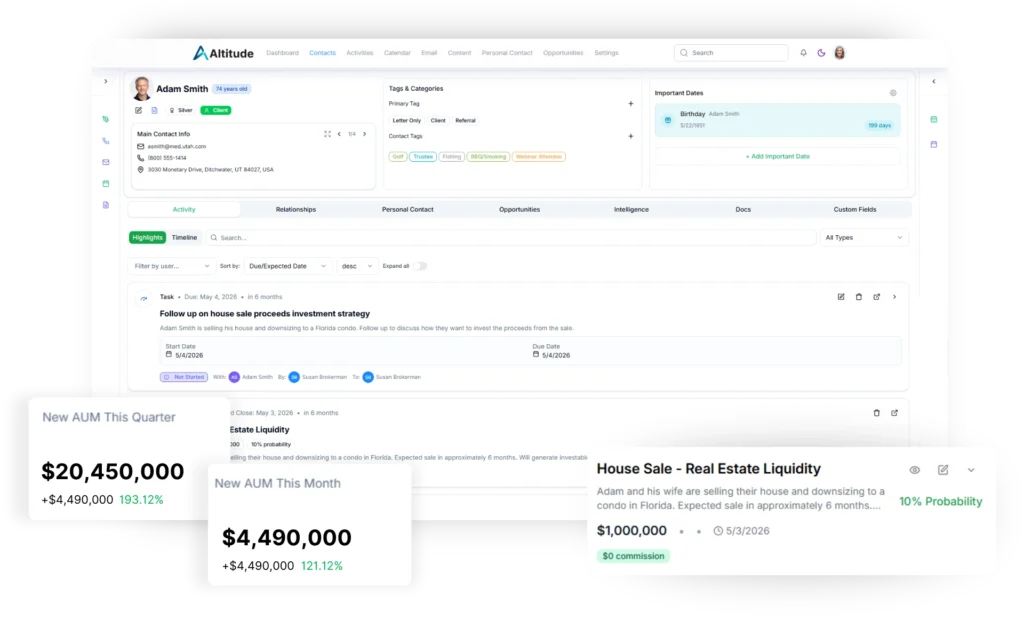
Introducing Altitude CRM: Built for Advisors Who Fly Solo
Altitude CRM isn’t a generic sales tool that’s been tweaked to fit the financial services industry. It’s not a massive enterprise platform that got a financial planning skin slapped on top. It was designed specifically for financial advisors from the very beginning, and that difference shows up in everything from the user-friendly interface to the way workflows are structured.
The tagline on our site says it well: everything you need, nothing you don’t. For a solo advisor, that’s not just a marketing line. It’s a genuine value proposition.
Your AI-Powered Assistant Is Already Included
One of Altitude CRM’s biggest differentiators is Pathfinder AI, a built-in AI-powered assistant that lives natively inside the platform. No integrations required. No extra cost. No setup. You just open Altitude and it’s there, ready to work.
Pathfinder lets you log client notes by talking or typing naturally. You can say something like “Add a note to Sarah Johnson’s account about today’s retirement review” and Pathfinder handles the formatting, tagging, and record-keeping automatically. It can pull up client information in real-time, navigate the platform on your behalf, manage your calendar, and kick off tasks, all from a single command.
Think of it like having a sharp, organized assistant who works around the clock, never forgets a detail, and never asks for a raise. For a solo advisor with no support staff, that’s not a small thing. That’s a practice-changer.
An All-in-One Platform That Actually Lives Up to the Name
A lot of CRM platforms claim to be all-in-one, offering features like a client portal. Altitude actually delivers it. Client communication, contact management, workflow automation, opportunity tracking, calendar and email sync, task management, reporting, and AI assistance, it’s all inside one platform with no add-ons required.
That matters for solo advisors because every disconnected tool in your tech stack is another place for client data to get lost, another login to remember, and another bill at the end of the month. Altitude keeps everything under one roof so your ecosystem stays clean and your focus stays on your clients.
Built to Scale as Your Practice Grows
You might be solo today, but Altitude was built with your future in mind too. As your AUM grows and your client list expands, the platform scales with you. You won’t hit a ceiling and have to migrate to a new system. The CRM features, automation capabilities, and AI tools that serve you as a solo advisor today will continue to serve you as your practice evolves.
Key Features That Make Altitude the Best CRM for Solo Financial Advisors
Let’s get into the specifics. Here’s what you actually get when you use Altitude as your CRM solution.
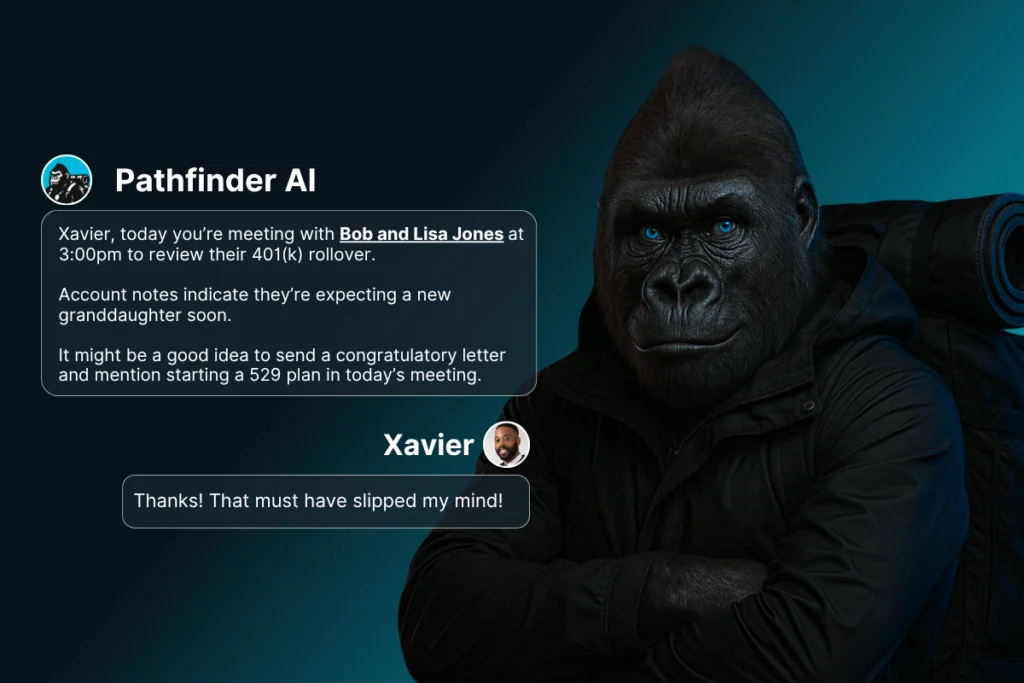
Pathfinder AI: Your Always-On Practice Assistant
We touched on Pathfinder AI above, but it deserves a deeper look because it’s unlike anything built into other advisor CRMs. Most AI tools in the CRM space are bolt-on integrations that require setup, subscriptions, and a fair amount of patience. Pathfinder is different. It’s native to Altitude, meaning it understands your client data, your workflows, and the structure of your practice from day one.
Here’s what it can do right now. It logs client notes from natural language commands. It surfaces key client information in seconds, last contact date, upcoming birthdays, service level, open tasks. It navigates the platform for you so you’re not clicking through menus. It manages calendar entries and links activities back to client records. And it gets smarter the more you use it, adapting to how you work over time.
Coming soon: Pathfinder+ will add meeting transcription and summaries. Pathfinder Pro will bring proactive coaching and growth recommendations built on decades of real advisor best practices. That’s a roadmap worth paying attention to.
Contact and Client Management: Every Relationship in One Place
For financial advisors, contact management isn’t just about storing names and phone numbers. It’s about knowing the full picture of every client relationship at a glance. Altitude handles households, companies, and individual contacts all within the same system. You can tag and segment clients, filter by service level or life stage, and see complete communication history without digging through old emails.
Client segmentation is especially powerful for solo advisors. When you can quickly identify which clients are approaching retirement, which ones haven’t heard from you in 90 days, and which prospects are warming up in your sales pipeline, you can prioritize your outreach in a way that actually moves your practice forward.
Opportunity Pipeline: Know Where Every Deal Stands
Altitude CRM’s opportunity pipeline is a visual system that maps your real sales process, not some generic template designed for software salespeople. This also allows for better forecasting. You can customize the stages to reflect how you actually work with prospects, from first meeting to signed agreement. Every opportunity is tracked, every next step is visible, and nothing gets lost in the shuffle.
For solo advisors managing lead generation without a small team, this kind of clarity is everything. You shouldn’t have to hold your entire sales pipeline in your head. Altitude holds it for you.
Smart Email and Letters: Personal Outreach at Scale
Altitude’s client communication tools let you merge contact details directly into emails and printed letters so every message feels one-to-one, even when you’re reaching your entire book at once. Automated birthday letters, annual review reminders, targeted email marketing campaigns, all of it runs through one system with templates ready to go.
This is where marketing automation earns its keep for solo advisors. You set up the sequence once. Altitude handles the execution. Your clients feel taken care of. And you didn’t have to manually send a single email.
Workflows and Automations: Your Practice Runs Even When You’re Not Looking
This is one of the most valuable CRM features for any solo advisor. Altitude lets you build workflows that automatically assign tasks, trigger client communication, move prospects through your pipeline, and keep your business processes on track without constant manual input.
Imagine a new prospect fills out your contact form. Altitude automatically creates a contact record, assigns you a follow-up task, and kicks off a welcome email sequence. No data entry. No dropped balls. Just a smooth, professional client onboarding experience that runs itself.
That’s workflow automation working the way it should.
Calendar and Email: Everything Connected Through Microsoft
Altitude CRM syncs two ways with Microsoft Outlook, which is a big deal for advisors who live in the Microsoft ecosystem. Your appointments, tasks, and client interactions all stay linked. You can book meetings, view your schedule, and tie every activity back to the right client record without ever leaving the platform.
No more toggling between your calendar app and your CRM. No more wondering if that meeting got logged. It’s all connected and seamlessly integrated in one place.
Task Management: Your To-Do List, Organized and Prioritized
Every task in Altitude is tied to something meaningful: a client, a deal, a workflow, or a deadline. You log in each morning and your priorities are right there waiting for you. Nothing buried. Nothing forgotten. Just a clear picture of what needs to happen today.
For solo advisors, that kind of daily clarity is the difference between a reactive day and a productive one.
Reporting and Dashboards: Know What’s Actually Moving the Needle
Altitude’s reporting tools give you dynamic dashboards and performance metrics so you always know where your practice stands. Which prospects are close to closing? Which clients haven’t been contacted recently? Which activities are actually driving growth? The answers are right there in your dashboard, updated in real-time.
Good metrics don’t just tell you where you’ve been. They help you decide where to go next.
A Day in the Life With Altitude CRM
Sometimes the best way to understand a tool is to see it in action. So let’s walk through what a typical day looks like for a solo financial advisor running their practice on Altitude.
Morning: Start With Clarity, Not Chaos
You open Altitude and Pathfinder AI surfaces your priority tasks for the day. Three follow-ups, a client review meeting at 10 AM, and a prospect who’s been sitting in your pipeline for two weeks without contact. You didn’t have to build this list yourself. Altitude built it for you overnight.
You type a quick note from yesterday’s call that you forgot to log. Pathfinder formats it, tags it to the right client record, and timestamps it automatically. Took about 15 seconds.
Mid-Morning: A New Prospect Enters the Picture
A referral reaches out through your website. Their information flows into Altitude automatically, a new contact record is created, and a follow-up task is assigned to you with a suggested timeline. Your workflow automation kicks off a personalized welcome email while you’re still in your 10 AM meeting.
By the time you check your dashboard at 11 AM, the prospect is already moving through your sales pipeline.
Afternoon: Staying Top of Mind Without the Manual Work
A long-time client hits their six-month check-in window. Altitude CRM flags it, and a personalized email goes out automatically. Another client has a birthday this week, the letter was already sent. You didn’t schedule either of these. They just happened because you set up the workflow once and Altitude handles the rest.
This is what consistent client service looks like without a support staff.
End of Day: A Quick Look at the Scoreboard
You pull up your reporting dashboard before closing out. Pipeline metrics look healthy. Two prospects moved forward this week. One client relationship needs attention. You make a note, assign yourself a task, and log off knowing exactly where things stand.
No spreadsheets. No sticky notes. No lying awake at night wondering what fell through the cracks.
That’s Altitude doing what the best CRM for solo financial advisors should do: giving you your time back while making your practice run better.
How Altitude CRM Compares to the Alternatives
Here’s the honest truth: every CRM solution on the market has something going for it. Redtail CRM has been around for years and has deep roots in the financial advisory space. Wealthbox is clean and modern. Salesforce Financial Services Cloud is incredibly powerful. HubSpot is great for marketing automation. AdvisorEngine brings solid portfolio management capabilities to the table.
But when you stack them up specifically against the needs of a solo financial advisor, a clear pattern emerges. And it’s not in their favor.
| What Solo Advisors Need | Redtail | Wealthbox | Salesforce | HubSpot | Altitude CRM |
| Purpose-built for financial advisors | Yes | Yes | Partially | No | Yes |
| User-friendly interface | Moderate | Good | Complex | Good | Yes |
| Built-in AI assistant | No | Add-on | Add-on | Add-on | Yes |
| Workflow automation | Limited | Limited | Yes | Yes | Yes |
| All-in-one platform (no add-ons) | No | No | No | No | Yes |
| Priced for solo practices | Moderate | Moderate | Expensive | Varies | Yes |
| Steep learning curve | Moderate | Low | High | Moderate | Low |
| Scales with growth | Yes | Yes | Yes | Yes | Yes |
What the Table Tells You
Redtail and Wealthbox are industry-specific, which gives them a leg up on generic platforms like Salesforce and HubSpot. But neither one offers a built-in AI-powered assistant, and both require add-ons to fill gaps in their functionality. For a solo advisor trying to streamline operations without managing a complicated tech stack, that matters.
Salesforce Financial Services Cloud is the heavyweight in the room. Its integration capabilities and scalability are genuinely impressive. But the pricing, implementation complexity, and steep learning curve make it a tough sell for anyone running a solo shop. It’s a Ferrari when most solo advisors need a reliable, well-equipped truck.
HubSpot shines for email marketing and lead generation, but it wasn’t built for the financial services industry. You’ll spend real time forcing it to fit advisory workflows it wasn’t designed for.
Altitude CRM sits in a different lane. It’s purpose-built for financial advisors, priced for practices of all sizes, and ships with Pathfinder AI included at no extra cost. It’s the only option on this list where you get an all-in-one CRM platform with built-in AI assistance, workflow automation, and industry-specific functionality without stitching together a patchwork of add-ons and integrations.
For solo advisors, that combination is hard to beat.
Getting Started With Altitude CRM
One of the biggest barriers to adopting new CRM software is the onboarding process. Nobody wants to spend three weeks configuring a system before they can send a single email. Altitude was built to get you up and running fast. The user-friendly interface means you’re not fighting the platform on day one. And because Pathfinder AI is already built in, there’s nothing to install, connect, or configure on the AI side.
Switching From Another CRM? We’ve Got You Covered.
If you’re currently using Redtail, Wealthbox, or another CRM system, Altitude CRM offers dedicated data migration support so your client data, contact records, and communication history make the move with you. You don’t have to start from scratch. That’s a big deal when your entire book of business lives in your current platform.
Book a Demo and See It for Yourself
The best way to know if Altitude is the right CRM for your practice is to see it in action. You can book a personalized demo and get a walkthrough tailored to how you actually work. No pressure. No jargon. Just a clear look at what the platform can do for a solo advisor like you.
Bottom Line: Your Practice Deserves More
Here’s where we land. Solo financial advisors are running complex, relationship-driven practices with the resources of a one-person team. That’s not a weakness. That’s actually an incredible thing. But it means every tool in your tech stack has to pull its weight.
Most CRM platforms ask you to adapt to them. They hand you a complicated system, wish you luck, and call it a day. The best CRM for solo financial advisors does the opposite. It adapts to you. It learns how you work. It handles the admin so you can focus on what you actually do best: building client relationships, delivering smart financial planning advice, and growing your AUM.
That’s what Altitude was built to do.
It’s purpose-built for the financial services industry. It’s loaded with the CRM features that actually matter for solo advisors. It comes with Pathfinder AI ready to work on day one. And it’s priced to make sense for a solo practice, not a 200-person advisory firm.
If you’ve been getting by on spreadsheets, sticky notes, and good intentions, it’s time for a better system. And if you’ve tried other CRM software and walked away frustrated, Altitude is worth a serious look.
The best CRM for solo financial advisors isn’t the one with the longest feature list. It’s the one you’ll actually use every day, because it makes your work easier, your client service stronger, and your practice more sustainable.
Altitude CRM checks every one of those boxes.