

Choosing a CRM used to be simple.
You picked a tool to store contacts, log notes, and maybe set a few reminders. Done.
That approach doesn’t work anymore.
In 2026, financial advisors are running more complex businesses. Clients expect faster responses, better organization, and a more polished experience. Teams are larger. Workflows are messier. Data lives in too many places. And suddenly, your CRM isn’t just a digital filing cabinet. It’s the backbone of how your firm operates.
That’s why more advisors are taking a hard look at Wealthbox and asking an important question.
Is this still the right CRM for where my firm is headed?
Wealthbox is known for being user-friendly and easy to adopt. For many small to mid-sized advisory firms, that simplicity has been a real advantage. But as firms grow, simplicity can turn into friction. Advisors start wanting more automation. Better workflows. Deeper integrations. Clearer visibility into what’s happening across clients, tasks, and opportunities.
That’s usually the moment when the search for Wealthbox alternatives begins.
This guide walks through the top Wealthbox CRM competitors for 2026 and explains where each platform fits best. More importantly, it shows why Altitude CRM stands apart as the most complete, purpose-built CRM platform for financial advisors who want to scale without adding chaos.
Think of it like upgrading from a basic tool belt to a fully equipped workshop. Both get the job done. One just makes everything easier, faster, and far more consistent.
Why Look for a Wealthbox CRM Alternative in 2026?
Most advisors don’t wake up one day and say, “I need a new CRM.”
What usually happens is slower.
You notice follow ups slipping through the cracks. Your team starts building workarounds. You copy the same data into three different systems. Reports take longer to pull. Tasks live in too many places. Things still work, but they don’t flow.
That’s the warning sign.
As advisory firms grow, the job of a CRM changes. It can’t just store contacts anymore. It has to run the business.
In 2026, financial advisors are looking for more than basic client management. They want a CRM platform that can:
- Automate routine work instead of creating more of it
- Support real workflows, not just lists of tasks
- Connect cleanly with email, calendars, and other core tools
- Show what’s happening across the firm in real time
- Scale as the team grows without becoming harder to use
Think of it like upgrading from a paper planner to a digital system that actually organizes your life. A planner helps you remember. A system helps you operate.
Wealthbox has built its reputation on ease of use. And for many firms, that’s still valuable. But as client relationships deepen and operations become more complex, advisors often find themselves wanting more functionality. More automation. More control over workflows. Better visibility into client data and firm activity.
In short, they want a CRM that doesn’t just hold information, but actively helps run the business.
That’s why so many advisors are exploring Wealthbox alternatives. Not because Wealthbox stopped working. But because their firm outgrew what “simple” can offer.
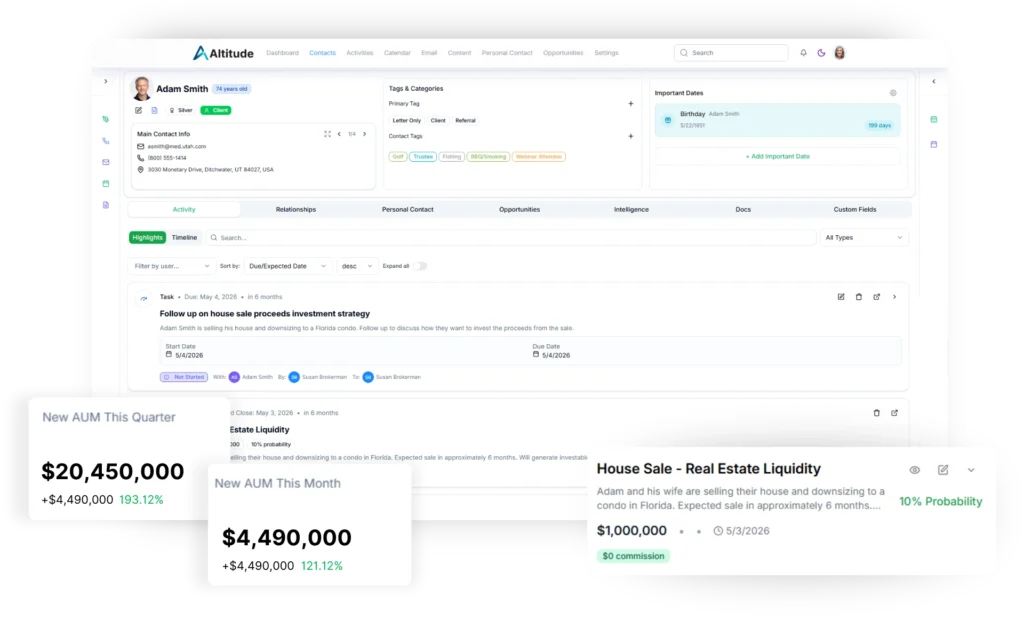
1. Altitude CRM: The Best CRM Platform for Financial Advisors in 2026
If most CRMs feel like tools you have to adapt to, Altitude feels like it was built around how advisory firms actually work.
Because it was.
Altitude CRM wasn’t designed as a generic sales system and then retrofitted for financial services. It was purpose built from the ground up for financial advisors who need more than contact management. It’s designed to run the business, not just record it.
Think of the difference between a filing cabinet and a real operating system. One stores information. The other helps everything move in the right direction.
That’s the gap Altitude fills.
Why Choose Altitude CRM Over Wealthbox?
Wealthbox focuses on simplicity and ease of use. That works well early on. But as your firm grows, simplicity can become a ceiling.
Altitude takes a different approach. It’s built as an all-in-one CRM platform that brings together client management, automation, workflows, AI-assisted insights, and financial operations in a single system. Instead of juggling tools and patching things together, everything lives in one place.
Where Wealthbox helps you stay organized, Altitude helps you run the business.
It’s the difference between writing notes about what you plan to do and having a system that quietly makes sure the right things actually happen.
AI That Works With You, Not Against You
One of the clearest differentiators for Altitude in 2026 is the way built-in AI amplifies advisor productivity without overwhelming users.
Altitude’s AI (Pathfinder) doesn’t just summarize information, it helps you do work you would have otherwise had to do manually. Here’s how:
- Intelligent task and workflow suggestions: Altitude analyzes patterns in your data and suggests the next logical action, so follow-ups never fall through the cracks.
- Smart opportunity prioritization: Pathfinder AI highlights which clients and opportunities matter most based on engagement, activity, and financial signals.
- Context-aware client insights: Without digging through records, you get AI-generated summaries of client histories, open items, and relevant next steps.
The goal isn’t automation for its own sake. It’s automation that feels like a partner: saving time, reducing oversight risk, and making sure nothing important slips through.
Strengths of Altitude CRM
Altitude is designed to remove friction from everyday work while giving advisors clearer visibility into what matters most.
Here’s where it stands out:
- Purpose built for financial advisors: Every workflow is designed around how advisory firms operate. No generic sales processes. No unnecessary layers.
- True automation, not just reminders: Tasks, follow ups, and processes move forward automatically. Less manual work. Fewer dropped balls.
- AI-assisted insights and prioritization: Built-in intelligence helps you focus on what matters instead of what’s loudest.
- Smart dashboards that show what matters
Instead of digging through reports, you see key activity, opportunities, and client data in one clean view. - Seamless client and contact management: Client data, communication history, tasks, and financial information stay connected so nothing lives in isolation.
- Built in onboarding and templates: New clients, new team members, and recurring processes follow consistent systems without reinventing the wheel each time.
- Email integration and real time notifications: Your CRM stays in sync with how you actually communicate. No more hunting for information across platforms.
- Scales without becoming harder to use: Whether you’re a solo advisor or a growing RIA, Altitude expands with your firm without adding clutter or complexity.
It’s designed so your technology works the way a great assistant would. Quietly. Reliably. Always one step ahead.
Why Altitude CRM is the #1 Wealthbox Alternative
Other platforms improve parts of the job. Altitude improves the whole operation.
It isn’t just a CRM solution. It’s a complete CRM platform built to support real workflows, real client relationships, and real business growth. Everything is connected. Everything is purposeful. And everything is designed to make the firm run better, not just look more organized.
If you’re looking for something that simply replaces Wealthbox, there are options.
If you’re looking for something that upgrades how your firm operates, and does more of the work for you, Altitude stands alone.
2. Redtail CRM
Redtail CRM has earned its reputation by doing one thing well. It brings structure to advisory firms that care deeply about organization, documentation, and compliance.
If Altitude is designed to help run the business, Redtail is designed to help keep it in order.
That makes it a solid option for firms whose top priority is staying consistent, documented, and audit ready.
Where Redtail CRM Shines
Redtail is built specifically for financial professionals, and that shows in a few key areas.
- Strong compliance workflows: Activities, notes, and client interactions are easy to track and document. For firms that need clear records, this matters.
- Reliable client and contact management: Client data is structured and easy to access. Communication histories stay tied to the right records.
- Broad integration ecosystem: Redtail connects with many planning, portfolio, and custodian platforms commonly used by advisors.
In short, Redtail does a good job helping advisors stay organized and consistent.
Drawbacks to Consider
Where Redtail starts to show its limits is in how much it helps you move forward, not just stay in line.
- Automation is limited: While Redtail supports basic workflows, it lacks deeper automation that can truly reduce manual work. Many tasks still require hands-on effort.
- Workflows can feel rigid: Customizing processes often means working around the system instead of with it. Firms with unique or evolving workflows may feel boxed in.
- User experience feels dated: The interface works, but it does not offer the clean, modern experience many advisors now expect.
Think of Redtail like a well-organized filing system. It keeps everything where it should be. What it does not do is tell you what should happen next or help execute it automatically.
Redtail CRM as a Wealthbox Alternative
Redtail is a strong alternative to Wealthbox for advisors who want more structure and better compliance support. But for firms looking for a system that actively helps run the business, streamline workflows, and surface what matters most in real-time, Redtail stops short.
3. Salesforce
Salesforce is one of the most powerful CRM platforms in the world. It’s built for large organizations that need deep customization, advanced reporting, and the ability to manage complex operations across many teams.
For massive enterprises, that power can be a real advantage.
For most advisory firms, it can feel like bringing a freight train to run a local delivery route.
Where Salesforce Shines
Salesforce earns its reputation in a few clear areas.
- Unmatched customization: Nearly every part of the system can be configured. Fields, workflows, dashboards, and reports can be built to match almost any business model.
- Advanced analytics and reporting: Salesforce provides deep insight into activity, pipelines, and performance. For large firms, this level of data visibility is valuable.
- Massive integration ecosystem: With thousands of third party tools and open APIs, Salesforce connects to almost anything.
- Enterprise-grade scalability: If you’re managing multiple departments, offices, or business units, Salesforce can handle the complexity.
In other words, Salesforce is incredibly capable.
Drawbacks to Consider
That same power is also what makes Salesforce difficult for many financial advisors to use effectively.
- Not built for financial advisors: Salesforce is a general business platform. Financial workflows, compliance needs, and client relationship models must be custom built.
- Complex setup and admin: Most firms need consultants or dedicated administrators to configure and maintain the system. This adds time, cost, and ongoing dependency.
- Expensive at scale: Licensing, add ons, and customization costs rise quickly, especially for growing teams.
- Overkill for most advisory firms: Many advisors only use a fraction of what Salesforce can do, yet still carry the burden of its complexity.
Salesforce is like owning a high performance sports car in city traffic. It’s impressive. It’s powerful. But it’s rarely the most practical way to get where you need to go.
Salesforce as a Wealthbox Alternative
Salesforce is a legitimate alternative to Wealthbox for very large firms that require enterprise infrastructure and have the resources to manage it.
For most financial advisors, however, it introduces complexity without delivering proportionate operational value.
4. HubSpot CRM
HubSpot is widely known as a marketing platform that happens to include a CRM. For firms that prioritize lead generation, email campaigns, and online engagement, that combination can be appealing.
If your biggest challenge is getting in front of more prospects, HubSpot brings a strong set of tools to the table.
Where HubSpot CRM Shines
HubSpot’s strengths show up most clearly on the marketing side.
- Powerful marketing automation: Email campaigns, lead nurturing, and follow up sequences are easy to build and manage.
- Clean, user-friendly interface: The system is intuitive, which helps teams adopt it quickly without heavy training.
- Strong email and communication tools: Email integration, tracking, and activity logs make it easy to monitor outreach.
- Built-in social and campaign management: Marketing efforts can be managed from a single place, which simplifies reporting and coordination.
For advisory teams focused on visibility and growth through marketing, HubSpot can feel like a step forward.
Drawbacks to Consider
Where HubSpot begins to fall short is in the day-to-day operations of a financial advisory business.
- Not built for financial planning or advisory workflows: HubSpot is designed around sales funnels, not client relationships that span decades.
- Limited handling of financial and client data: While it manages contacts well, it lacks native support for the data structures advisors rely on.
- Requires multiple add-ons to function as a full CRM platform: Many operational features live outside the core system, increasing cost and complexity.
- Marketing-first, not operations-first: HubSpot helps you attract leads. It does less to help you manage and grow existing client relationships efficiently.
Think of HubSpot like a strong front door for your business. It brings people in. What it does not do particularly well is help run everything that happens once they are inside.
HubSpot as a Wealthbox Alternative
HubSpot is a viable alternative to Wealthbox for firms that care most about marketing automation and outreach. But for advisors who need a system that supports financial planning, long-term client relationships, and operational workflows, HubSpot does not go far enough.
5. Zoho CRM
Zoho appeals to firms that want a lot of control without a high price tag. It’s a broad CRM platform that can be customized in many ways, which makes it attractive to cost conscious teams and tech savvy users who don’t mind configuring their own systems.
If flexibility and affordability are your top priorities, Zoho is often part of the conversation.
Where Zoho CRM Shines
Zoho offers a wide feature set for the price.
- Strong customization options: Fields, workflows, and layouts can be adjusted to fit different business models.
- Built in automation tools: Advisors can create rules, triggers, and task flows to reduce repetitive work.
- Cloud based and accessible from anywhere: Teams can work from any location without complex infrastructure.
- Budget friendly pricing: Compared to enterprise platforms, Zoho is affordable for small businesses and growing firms.
For advisors who want flexibility and are comfortable tailoring their own systems, Zoho provides a lot of functionality for the cost.
Drawbacks to Consider
The same flexibility that makes Zoho appealing can also make it harder to use effectively in a financial advisory environment.
- Not purpose built for financial advisors: Advisory workflows, compliance processes, and client relationship models must be created manually.
- Steeper learning curve
The interface and configuration options can feel overwhelming, especially for teams that want a simple, guided experience. - Financial data requires heavy setup: Zoho does not natively support the structures advisors rely on, which means more customization and ongoing maintenance.
- Fragmented experience at scale: As firms grow, managing multiple modules and integrations can start to feel disjointed.
Zoho CRM is like buying a toolkit instead of a finished system. You get the parts. You still have to build the machine.
Zoho as a Wealthbox Alternative
Zoho is a legitimate alternative to Wealthbox for firms that want flexibility at a lower cost and don’t mind configuring their own workflows. But for advisors who want a system that already understands their business, reduces setup time, and supports long term growth without added complexity, Zoho falls short.
Comparison: Wealthbox vs Top Alternatives in 2026
| CRM | Best For | Key Strengths | Limitations |
|---|---|---|---|
| Wealthbox CRM | Small to mid sized advisory firms | Ease of use, simple contact management | Limited automation, basic workflows, less scalability |
| Altitude CRM | Modern financial advisors and RIAs | All-in-one platform, automation, AI insights, purpose built workflows | Fewer integrations than competitors at launch, (Jan. 2026) |
| Redtail CRM | Compliance focused firms | Client documentation, integrations, customer support | Rigid workflows, limited automation, dated interface |
| Salesforce | Enterprise wealth firms | Customization, analytics, integrations | Complex, expensive, not advisor native |
| HubSpot CRM | Marketing driven teams | Marketing automation, email tools, user friendly design | Not built for financial planning or operations |
| Zoho CRM | Budget conscious firms | Flexibility, automation, affordable pricing | Steep learning curve, not purpose built for advisors |
Which Wealthbox CRM Alternative Is Best for You?
- If your priority is compliance and structure, Redtail may fit.
- If you run a large enterprise with technical resources, Salesforce can handle the scale.
- If marketing is your main focus, HubSpot is a strong front end tool.
- If affordability and customization matter most, Zoho offers flexibility.
But if you want a CRM platform that brings everything together, client relationships, workflows, automation, financial management, and AI driven intelligence, there is one clear choice.
Altitude CRM is the best overall Wealthbox alternative for financial advisors in 2026.
It is purpose built for how wealth management firms actually operate. It reduces manual work. It improves clarity. And it helps your firm move forward with less friction and more confidence.
Choosing the Right Wealthbox CRM Alternative
By now, one thing should be clear. There is no shortage of CRM software on the market. But there is a big difference between a tool that stores information and a platform that actually helps run a financial advisory firm.
- Redtail helps firms stay organized and compliant.
- Salesforce delivers raw power for enterprise operations.
- HubSpot shines in marketing and outreach.
- Zoho offers flexibility at a lower cost.
Each of these platforms does something well. Each also comes with tradeoffs.
What most advisors are really searching for in 2026 is not just better contact management. They want a CRM system that can:
- Support real workflows instead of creating more manual work
- Automate routine tasks without feeling complicated
- Centralize client data and financial information
- Provide clear visibility into what is happening across the firm
- Scale as the business grows without becoming harder to use
In other words, they want a system that feels less like software and more like an operating partner.
That is exactly where Altitude stands apart.
Altitude CRM was created as a purpose-built, all-in-one CRM platform for financial advisors. It unifies client management, automation, workflows, and AI driven intelligence into a single system that helps firms operate better every day. It does not just track activity. It guides it. It does not just store data. It turns that data into direction.
If your firm has outgrown basic simplicity and you are ready for a system that supports real growth, clarity, and execution, Altitude is a clear winner.