
Why Canadian Financial Advisors are Rethinking their CRM Software
For years, CRM software was treated like a digital filing cabinet.
A place to store names, emails, and a few notes. Something you updated after the fact. Something you hoped your team actually used.
That version of customer relationship management no longer works.
Today’s Canadian financial advisors are navigating tighter margins, higher service expectations, and more complex client relationships. Households are larger. Client portfolios are more layered. Client communication happens across meetings, email, phone calls, and follow-ups that can’t afford to fall through the cracks.
At the same time, firms are being asked to document more through detailed audit trails and compliance tracking while doing less manual data entry.
That’s why the conversation has shifted from simply choosing a CRM system to choosing the right purpose-built CRM for financial advisors.
Modern CRMs must do far more than store client data, customer data, and sensitive financial data. They need to support real workflows, streamline business processes, improve client interactions, and help advisors deliver a consistent client experience across their entire book.
For wealth management firms in Canada, the right platform should connect client information, data residency requirements, financial planning conversations, follow-up activity, and long-term relationship management in one place.
Because when your CRM actually supports how financial services firms operate, it stops being software you tolerate and becomes infrastructure your business depends on.
That’s exactly what separates the best CRMs from the rest.
How We Evaluated the Best CRM Solutions for Canadian Advisors
Choosing the right CRM for financial advisors is less about flashy CRM features and more about how well the system supports day-to-day execution.
To build this list of the best CRMs used by Canadian financial advisors, we evaluated each platform across the areas that actually determine success inside an advisory firm.
1. Client Relationships & Visibility
At its core, customer relationship management and client management are about understanding people, improving retention, and delivering exceptional client service.
That means having clear access to client information, household structures, client profiles, and historical client interactions all in one place. Advisors should be able to see conversations, notes, tasks, and activity without jumping between systems.
When client data is fragmented, relationships suffer. When it’s centralized, advisors can deliver a stronger and more consistent client experience.
2. Automation & Workflow Execution
Modern advisory firms cannot rely on memory or manual task lists.
We looked closely at how each CRM supports automation and workflow automation. This includes recurring service workflows, meeting-based follow-up, task creation, and reminders that help teams streamline their week.
The goal is simple. Reduce data entry. Increase consistency. Eliminate missed follow-ups.
CRMs that support real workflows allow advisors to spend more time serving clients and less time managing systems.
3. Integrations & Connected Tools
No CRM operates in isolation.
Canadian advisory firms depend on integrations with tools like Microsoft Outlook or Gmail, email and calendar platforms, portfolio management systems, financial planning tools, and document management software.
We evaluated how well each CRM connects with existing technology and whether those integrations function in real time or require manual workarounds.
A disconnected tech stack creates friction. A connected ecosystem supports growth.
4. Scalability and Long-term Fit
A CRM that works for a firm today must also work five years from now.
We considered how each platform handles team growth, increased client portfolios, and expanding service models. Scalability matters not only in user count but in how well workflows, dashboards, permissions, and reporting evolve as firms grow.
The right CRM system should support growth without forcing firms to constantly rebuild their business processes.
5. Ease of Use & Onboarding
Even the most powerful CRM fails if no one uses it.
We evaluated ease of use, onboarding experience, the quality of customer support, intuitive interface design, and how quickly teams can become productive. A user-friendly CRM drives adoption, improves client communication, and ensures consistent activity across the firm.
The best platforms balance power with simplicity.
6. Reporting, Dashboards, & Insights
Visibility drives better decisions. Strong dashboards and reporting tools help advisors understand key metrics like client engagement, service activity, pipeline movement, forecasting, and follow-up completion. When CRM data is organized and optimized, firms gain valuable insights that support better planning and stronger relationships.
A CRM should not just store information. It should help leadership see what’s happening across the business in real time.
Quick Comparison: Choosing the Right CRM for Canadian Financial Advisors
Every CRM on this list can technically manage contacts.
That’s not the problem most advisory firms are trying to solve.
The real challenge is finding a CRM system that supports how financial advisors actually work. Meetings, follow-up, documentation, client communication, and ongoing service workflows all need to live in one place.
Some platforms focus on flexibility. Others focus on simplicity. A few focus on deep automation.
Understanding these differences makes it much easier to choose the right CRM for your firm.
Below is a high-level breakdown of how each platform fits different types of Canadian financial advisors.
- Altitude CRM is designed for firms that want a complete operating system. It combines customer relationship management, workflow automation, meeting execution, dashboards, and real-time insights into a single cloud-based platform built specifically for financial advisors.
- Maximizer CRM appeals to firms that prefer a legacy CRM system with structured contact management and strong administrative control.
- Redtail CRM is widely known across the financial advisory industry for its consistency and advisor-focused approach to client information and follow-up tracking.
- Wealthbox CRM emphasizes simplicity, ease of use, and an intuitive interface that supports fast onboarding and high adoption.
- Zoho CRM offers deep customization and automation functions for firms willing to build and maintain their own system.
There is no universal solution that fits every firm. But when you compare these platforms side by side, one distinction becomes clear…
Some CRMs are designed to store information. Others are designed to run the business.
With that context in mind, let’s take a closer look at the best CRM software options available to Canadian financial advisors today, starting with the platform that stands apart from the rest.
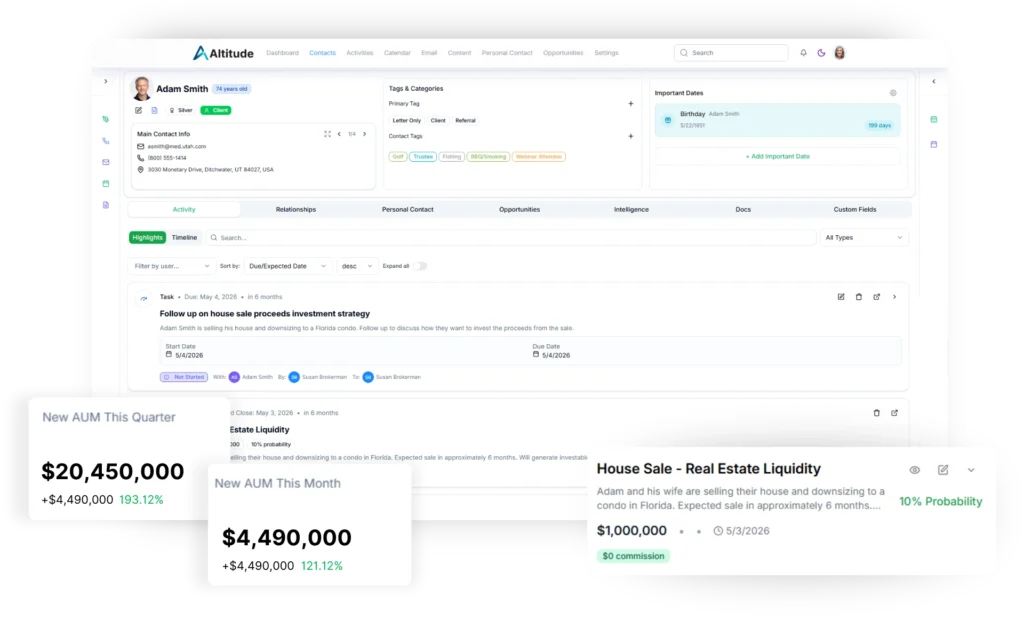
#1 – Altitude CRM: Best Overall CRM for financial advisors in Canada
Most CRM systems were built to record what already happened.
Altitude CRM was built to help advisors execute what needs to happen next.
From the ground up, Altitude was designed specifically as a CRM for financial advisors, not as generic sales software adapted for wealth management. It combines customer relationship management, workflow automation, meeting execution, and AI-driven insights into a single cloud-based platform.
Instead of forcing advisors to stitch together multiple tools and apps, Altitude brings everything into one place.
Strengths
Altitude is Built for Real Advisory Workflows
Advisory firms don’t operate like sales teams.
They operate around meetings, service models, financial planning conversations, and long-term client relationships. Altitude reflects that reality.
Client profiles are structured around households, relationships, and client portfolios. Advisors can view client information, meeting history, notes, tasks, documents, and follow-up activity without jumping between screens.
Workflows guide what happens before and after every meeting, ensuring no task or client interaction falls through the cracks. This structure allows firms to streamline operations while maintaining a consistent client experience across the entire team.
Altitude’s Workflow Automation Actually Reduces Workload
Automation only matters if it saves time.
Altitude includes native workflow automation designed around common financial advisory business processes. Tasks, reminders, and follow-ups can be triggered automatically based on meetings, status changes, or lifecycle events. That means less manual data entry and more consistent execution.
Rather than relying on memory, spreadsheets, or sticky notes, advisors operate with clarity around what needs to happen each day.
Altitude’s AI-powered Insights are Built Directly into the CRM
Altitude is an AI-native platform. Its built-in assistant, Pathfinder, helps advisors prepare for meetings, summarize client interactions, identify follow-up opportunities, and surface valuable insights across households.
Because the AI is embedded directly within the CRM system, it works from real client data in real time. The result is better preparation, stronger client communication, and more meaningful conversations tied directly to financial goals.
(For a broader look at how AI is transforming advisory work, explore the best AI tools for financial advisors.)
Altitude CRM is Designed for Scale and Long-Term Growth
As firms grow, complexity increases. Altitude was built with scalability in mind. Role-based permissions, dashboards, workflow ownership, and reporting tools allow teams to expand without losing visibility or consistency.
Whether a firm is managing hundreds or thousands of households, Altitude supports growth without requiring constant customization or system rebuilds.
Limitations
Altitude is a newer CRM platform compared to legacy systems that have been used by financial advisors for decades. Firms that place a high value on long operating history may want additional time to evaluate the platform.
The system is built around structured workflows and consistent execution. Teams coming from loosely organized CRM software may need an adjustment period as processes become more standardized. For firms planning a switch, a step-by-step approach to CRM migration makes the transition much smoother.
While integrations continue to expand, firms using highly specialized or proprietary tools should confirm compatibility during onboarding. Some niche systems may not yet be supported.
Altitude prioritizes best practice workflows over unlimited customization. Advisors who prefer a completely open-ended or build-your-own CRM environment may find the platform more guided than horizontal solutions.
Altitude CRM is Best Suited for:
- Independent financial advisors focused on growth
- Teams managing complex client relationships
- Firms seeking fewer tools and stronger execution
- Advisors who want their CRM to support financial planning, follow-up, and ongoing service models
Bottom line: Altitude delivers the strongest balance of automation, execution, and advisor-specific design available today. While newer than legacy platforms, it represents the direction CRM software for financial advisors is moving, not where it has been.

#2 – Maximizer CRM
Maximizer CRM has been around for decades and maintains a meaningful presence among Canadian financial advisors who prefer a more traditional, legacy CRM system.
It follows a familiar structure focused on contact management, task management, opportunity tracking, and activity logging. For firms that want control over how their CRM is configured, Maximizer provides flexibility through custom fields, reports, and dashboards.
Strengths
Maximizer performs well as a centralized database for client information. Advisors can track client profiles, contact details, tasks, and interaction history in one location.
The platform also offers reporting tools that support visibility into sales pipeline activity and client engagement, which can be useful for managers overseeing multiple advisors.
Limitations
Where Maximizer begins to show its age is in execution.
Workflow automation is limited compared to newer platforms, and many processes still rely on manual data entry. While integrations exist, they are not as seamless or real-time as modern cloud-based CRM solutions.
For firms focused on operational efficiency and streamlined follow-up, this can result in more administrative overhead.
Best suited for
- Canadian financial advisors comfortable with traditional CRM design
- Firms prioritizing administrative control over automation
- Teams with internal resources to manage CRM configuration
Maximizer remains a stable option, but it functions primarily as a system of record rather than a system of execution.
#3 – Redtail CRM
Redtail CRM is one of the most widely recognized legacy CRM platforms in the financial advisory industry.
Its reputation is built on consistency, advisor-focused design, and a long history of use within wealth management firms.
Strengths
Redtail excels at core customer relationship management.
It offers structured client profiles, activity tracking, notes, and follow-up tools that help teams maintain visibility across client interactions. Many advisors appreciate its standardized workflows and templates, which help ensure tasks are completed consistently across the firm.
Redtail also integrates with a wide range of financial services tools, including portfolio management and financial planning software.
Limitations
While reliable, Redtail has been slower to evolve.
The user interface can feel dated, and deeper automation often depends on third-party integrations rather than native workflow automation. Reporting and dashboards provide visibility but lack the real-time intelligence many modern firms expect.
For advisors seeking advanced automation or AI-driven insights, Redtail may feel limiting.
Best suited for
- Firms seeking an industry-standard CRM
- Advisors prioritizing familiarity and stability
- Teams focused on consistent documentation and follow-up
Redtail remains dependable, but it is best viewed as a foundational CRM rather than a growth platform.
#4 – Wealthbox CRM
Wealthbox CRM is known for its modern design and emphasis on simplicity. Among legacy CRMs used by financial advisors, it is often praised for being clean, intuitive, and easy to adopt.
Strengths
The platform’s intuitive interface makes onboarding fast and lowers resistance from team members. Activity feeds resemble social media timelines, which encourages daily use and improves visibility into client interactions.
Wealthbox performs well for contact management, client communication tracking, and basic workflow organization.
Ease of use is its defining feature.
Limitations
That simplicity comes with tradeoffs.
Wealthbox offers limited workflow automation compared to more robust CRM systems. Firms with complex service models often need additional tools for advanced automation, reporting, or process management.
As advisory firms scale, the platform may struggle to support deeper operational needs.
Best suited for
- Small to mid-sized advisory firms
- Advisors prioritizing ease of use and adoption
- Teams seeking a lightweight legacy CRM solution
Wealthbox delivers an excellent user experience, but it is not designed to function as a complete practice management system.
#5 – Zoho CRM
Zoho CRM is one of the most flexible platforms on the market and is widely used across many industries, including financial services.
It is not built specifically for financial advisors, but it can be adapted to meet unique operational needs.
Strengths
Zoho CRM, offers extensive customization.
Firms can build custom modules, automate workflows, create dashboards, and integrate marketing automation tools. For teams with technical resources, Zoho can be moulded into a highly tailored CRM solution.
Its scalability and pricing structure also make it attractive for growing organizations.
Limitations
Flexibility comes at the cost of simplicity.
Zoho CRM much like Salesforce; requires significant setup, ongoing maintenance, and internal ownership. Without clear governance, systems can become overly complex and difficult to manage.
Because it is not advisor-native, many financial planning and wealth management workflows must be built manually.
Best suited for
- Firms with dedicated operations or technology staff
- Advisors with highly customized business processes
- Teams comfortable maintaining a bespoke CRM system
Zoho is powerful, but success depends heavily on how well the system is designed and managed.
Final Thoughts: Choosing the Right CRM for your Canadian Firm
There is no shortage of CRM software available to Canadian financial advisors.
But not every CRM system is built for the realities of modern wealth management.
Some platforms focus on contact management. Others emphasize ease of use. A few provide deep customization. Only one is designed to unify workflows, automation, client communication, and execution in a single system.
The right CRM should help your firm:
- Improve client interactions
- Strengthen client relationships
- Reduce data entry
- Support financial planning conversations
- Scale without adding unnecessary complexity
When your CRM aligns with your unique needs, it stops being software you manage and becomes infrastructure that supports growth.
For many Canadian financial advisors, that distinction is exactly what separates the best CRMs from the rest.
Frequently Asked Questions about CRM Software for Financial Advisors in Canada
The best CRM for financial advisors in Canada is one that supports real advisory workflows, client relationships, and long-term scalability like Altitude CRM. While many CRM systems can store contact information, the strongest platforms combine customer relationship management, workflow automation, dashboards, and integrations into a single cloud-based solution. Advisors should look for CRM software built specifically for financial services rather than generic sales tools. For firms seeking automation, execution, and growth support in one platform, Altitude CRM stands out as the most complete option available to Canadian financial advisors.
While general CRM platforms can be adapted, CRM software designed specifically for financial services offers major advantages. Advisor-specific CRMs support households, client portfolios, recurring service workflows, compliance documentation, and long-term relationship management. These features reduce manual configuration and improve adoption across the firm. For most Canadian financial advisors, using a purpose-built financial advisory CRM leads to better efficiency and a stronger client experience.
Most modern CRM systems are cloud-based and designed with security and data protection in mind.
Canadian advisory firms should evaluate how CRM providers handle client data, access controls, encryption, and vendor security practices. While data residency may vary, reputable providers offer safeguards that meet the expectations of Canadian financial services firms. Cloud-based platforms like Altitude CRM also provide real-time access, automatic updates, and improved disaster recovery compared to on-premise systems.
While Salesforce can be optimized to support advisory workflows, many independent financial advisors find it complex compared to CRM systems built specifically for wealth management, like Altitude CRM.
Yes. CRM software like Altitude CRM can play a major role in identifying natural upselling opportunities. When client profiles, financial data, and interaction history are visible in one place, advisors can identify gaps in planning, insurance coverage, estate strategies, or investment alignment. Dashboards and reporting tools help surface these opportunities organically, allowing financial advisors to deepen relationships rather than force sales conversations.
To optimize a CRM system, advisors should focus on execution rather than configuration. This includes building repeatable workflows, standardizing follow-up processes, integrating key tools, and maintaining clean client data. The most successful firms treat their CRM as the operating system of the business, not just a database. A well-optimized CRM supports growth, improves accountability, and enhances the overall client experience.