Picture the last hour of your workday. You’ve got notes to write up from three client calls, a handful of follow-up emails you promised to send, and a client record that’s a couple conversations out of date. None of that work grows your business. All of it still has to get done.
That’s the gap AI fills for financial advisors. Used well, it clears the busywork so you can spend your hours on clients instead of cleanup. Used poorly, it’s one more login you forget about by Friday. The difference comes down to which tools you pick, and that’s what this article is about.
Most advisors lose the same hours to the same tasks:
- Writing up meeting notes and trying to remember what was said
- Sending follow-ups after every client meeting
- Keeping client data organized and current
- Staying on top of marketing and social media
- Reviewing portfolios, tracking goals, and prepping for planning conversations
AI can take a real bite out of every one of those. Some tools write compliant content. Some sit in your meetings and take notes. Others focus on planning or research. They don’t all do the same thing, and a few do very little once you get past the demo.
Below are the eight AI tools worth a financial advisor’s attention in 2026. You’ll see where each one earns its keep, where it falls short, and why Altitude comes out on top.ontent creation, and others on big-picture financial planning tools. The best ones cut your admin work without adding complexity to your day. And while tools like ChatGPT (OpenAI), Claude (Anthropic), Gemini, and even Wealthbox or Redtail have their strengths, you’ll see why Altitude stands out.
Why Financial Advisors Should Use AI in 2026
Here’s the short version of what AI can do inside an advisory practice:
- Send follow-up emails automatically so no prospect slips through the cracks
- Take notes during meetings and surface what matters while you’re still in the room
- Pull portfolio and account data instantly for reviews
- Run quick “what if” scenarios so clients can see a decision play out before they make it
- Flag accounts that need attention before a small risk becomes a real one
- Draft compliant content for newsletters and social posts
- Handle scheduling, reminders, and reporting on its own
AI won’t replace you. Your clients hired a person, and the relationship is still the whole job. What AI does is take the repetitive work off your desk so you have more time for that relationship. If you’re worried about the robo-advisor question, we wrote about that here.
Solo CFPs, large RIAs, and everyone in between are landing in the same place: knowing how to use AI is now part of the job.
1. Altitude CRM: The Best AI Tool for Financial Advisors
Most platforms bolt AI onto software that was built for generic sales teams, then hope it fits an advisory practice. Altitude went the other way. It was built for financial advisors from the ground up, and it pairs a full CRM with an AI assistant that does real work inside the system instead of handing you a transcript to sort out later.
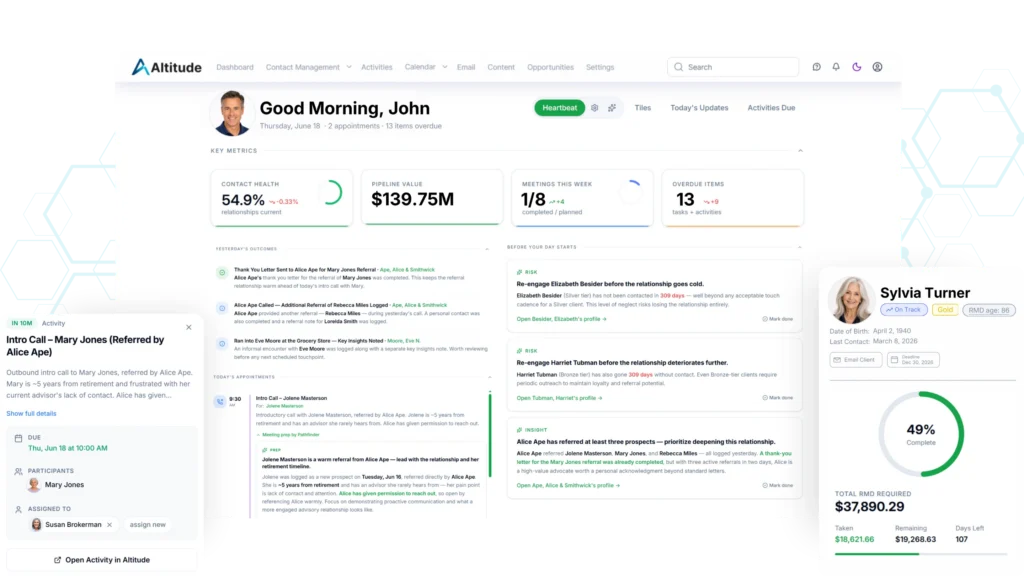
That assistant is Pathfinder+, and it’s the reason Altitude leads this list. Altitude’s Meeting Intelligence, Pathfinder +, sits in your client meetings, takes the notes, and then does the part you’d normally dread. It drafts the follow-up email, creates and assigns the tasks, and updates the client’s record, often before you’ve made it back to your desk. Think of it as an associate who’s in every meeting and has the paperwork done before you ask.
The help doesn’t stop when the meeting ends. Every morning, Altitude reads your book of business and hands you a one-screen briefing called Heartbeat. It tells you what closed or changed yesterday, what to handle before the day picks up, and how to prep for the meetings on your calendar. It also points out clients who are going quiet, so you can reach out before a good relationship drifts.
Compliance is built into the floor, not bolted onto the roof. Altitude can keep a locked record of who viewed or changed a client’s information, held for seven years, which is what SEC and FINRA books-and-records rules ask for. When an examiner asks who touched an account and when, you have the answer without calling your software vendor.
And because it’s one platform, your CRM, email, calendar, letters, mass mail, pipeline, and meeting notes all live in the same place. It connects with the tools you already run, including Microsoft Outlook, Google Workspace, and Zapier, and your data exports cleanly to Excel.
Where it’s strong:
- Purpose-built for CFPs, RIAs, and advisory firms, not repurposed sales software
- An AI assistant that finishes tasks instead of only suggesting them
- CRM, marketing, compliance, and practice management under one roof
Where it’s honest about limits:
- It’s built for financial advisors, so it’s not the pick for a general sales team
- As a newer CRM, it’s still adding third-party integrations
Bottom line: with most tools, AI is a feature you visit. With Altitude, it’s how the work gets done. Pathfinder+ takes action inside Altitude itself, which is what separates a real AI assistant from a fancy note-taker.

2. Jump AI
If your calendar is wall-to-wall client meetings, Jump AI is built for your week. It pulls together talking points from your client data before a meeting so you walk in ready, then drafts the notes, tasks, and follow-up emails once you’re done. It also runs sentiment analysis, which means it listens for the emotional cues in a conversation and flags things you might’ve missed, like a client who sounded uneasy about a decision. It keeps all of this inside the compliance rules you set up front.
The honest catch is that Jump suggests and drafts. It doesn’t execute. Someone on your team still has to take those drafted tasks and record updates and push them into your CRM. Jump works with platforms like Wealthbox and Redtail to close that loop. So if you already have a system of record and a person to do the last mile, Jump fills the meeting gap well. If you want the AI to actually finish the job, that’s where a platform like Altitude pulls ahead.
3. Zocks
Zocks is the lightweight option. Its focus is scheduling and keeping the small stuff tidy before and after a call: managing your calendar, sending client reminders, joining meetings to capture notes, and suggesting follow-ups. It’s easy to adopt and doesn’t ask much of you to get started.
That lightness is the trade-off. Zocks won’t create tasks or update client records on its own, and it’s not trying to be a full CRM. Think of it as a scheduling and note-taking layer that sits next to your system of record, not a replacement for it. If back-and-forth over meeting times is your biggest time sink, Zocks takes that off your plate.
4. Finmate AI
Finmate lives in the same neighborhood as Jump and Zocks. It preps you with talking points from client data, takes clean notes during the meeting, and drafts the follow-up emails and tasks afterward. Advisors who mostly want sharper notes and faster recaps tend to like it.
Where it helps most:
- Turning a messy meeting into a clear, usable summary
- Cutting the time you spend writing follow-ups by hand
- Keeping your client service consistent from one meeting to the next
The limit is the same one that follows this whole category: Finmate hands the work to your CRM rather than doing it there. Pair it with Redtail or Wealthbox and it’s a reasonable add-on to speed up your meeting cycle.
5. Zeplyn
Zeplyn is another AI meeting assistant, but it plants its flag on security. It uses end-to-end encryption and a recording-free approach to note-taking, with strict handling of client PII, which is the sensitive personal data you’re on the hook to protect. For advisors who lose sleep over where client information goes, that’s a real differentiator.
Underneath the security story, it does the meeting-assistant basics well. Zeplyn captures notes, action items, and the details that make a client feel remembered, like goals and life events. It drafts personalized follow-ups, preps recaps and agendas, and syncs notes to your CRM with a click.
Notice the word “sync.” Like the others in this group, Zeplyn still needs your CRM to carry out what it captures, and some of that syncing is on you. It’s an add-on, not a standalone system. But if compliance and data security top your list, Zeplyn deserves a hard look.
6. Perplexity
Every advisor knows the feeling of a client asking a sharp question mid-meeting, usually about a market that just dropped. Perplexity is built for that moment. It’s an AI search engine that answers questions in seconds and shows you its sources, so you can check market data or a tax rule without losing an hour to Google. It’s just as handy between meetings for research and prep, and it can help you rough out content like a newsletter or an FAQ.
Two things to keep in mind. Perplexity is general-purpose, so it doesn’t know your clients and won’t touch your records. And its answers pull from public sources, so anything you plan to put in front of a client needs a compliance check first. As a fast research companion, though, it earns its spot in the kit.
7. ChatGPT
If you’ve heard about AI at all, you’ve heard about ChatGPT. Built by OpenAI, it’s the Swiss Army knife of the group. Advisors reach for it to draft blog posts and newsletters, polish a client email, summarize a long report, or brainstorm when the blank page is winning. It can even power a chatbot on your website.
The flexibility is the whole appeal, and it’s real. The catch is that ChatGPT wasn’t made for financial services. It won’t manage your client data, and anything client-facing has to clear compliance before it goes out. Treat it as a writing and thinking partner rather than a system of record and it’s one of the most useful tools here.
8. Claude
Claude, created by Anthropic, is another AI-powered assistant built on LLMs. While it works in a similar space to ChatGPT, Claude, works in similar territory to ChatGPT but has a knack for long, dense documents. Hand it a contract, an estate planning file, or a wall of meeting transcript and it’ll give you back a clear, organized summary. That makes it a strong sidekick for document review and for pulling together background before a client meeting.
Same fine print as ChatGPT applies. Claude isn’t built for the financial services industry, it doesn’t plug into CRMs like Redtail, Wealthbox, or Altitude, and it needs your eyes on anything compliance-sensitive. But when the job is making a long, complicated document readable, Claude does that better than most.
Final Thoughts: Choosing the Best AI Tool for Your Firm
Notice the pattern in this list. Seven of these eight tools do a slice of the job well. Perplexity answers questions fast. ChatGPT and Claude help you write and make sense of long documents. Jump, Zocks, Finmate, and Zeplyn sit in your meetings and hand you clean notes and drafts. Every one of them leaves a task on your desk for someone to finish.
That’s the line worth paying attention to. A note-taker that drafts a follow-up email still needs a person to send it and log it. Multiply that by every client, every week, and the “time saver” starts eating the time it was supposed to save.
Altitude closes that loop. Pathfinder+ takes the note, writes the follow-up, creates the task, and updates the record inside Altitude, where the rest of your practice already lives. Heartbeat tells you each morning where your attention will pay off. The audit trail keeps you examiner-ready without extra work. You’re not stitching six tools together and praying they sync. You’re running one system that was built for how advisors actually work.
So here’s the recommendation. If you want a research helper, add Perplexity. If you want a writing partner, ChatGPT or Claude will do. If a meeting note-taker is all you’re after, any of the four will get you there. But if you want the AI to do the work instead of suggesting it, start with Altitude and add the others as you see fit.
Book a demo and see what a day looks like when the software finishes the job.
Frequently Asked Questions About AI Tools for Financial Advisors
Altitude CRM is our pick, and yes, we’re biased, so here’s the reason. It was built for advisors, RIAs, and wealth management firms rather than adapted from generic sales software. Its Pathfinder+ assistant sits in your meetings, updates client records, and creates follow-up tasks inside your system instead of leaving that work for you.
AI takes the repetitive admin off your plate: meeting notes, follow-up emails, research, and data entry. Meeting assistants like Jump, Finmate, and Zeplyn handle prep and note-taking, then hand the work to whatever CRM you run. Altitude is the CRM, so it goes a step further and completes those actions itself. The notes, the follow-up, and the tasks all land in the same system, and the work doesn’t wait on a free afternoon.
Jump AI, Zocks, Finmate, and Zeplyn all capture notes, summaries, and follow-up suggestions. They make prep and recap easier, then rely on a separate CRM to act on what they gathered. Altitude is different because it is the CRM. Pathfinder+ records the notes, then updates the client record and creates the tasks right there in Altitude, automatically after the meeting.
General AI tools like ChatGPT, Claude, and Perplexity are great for writing, research, and brainstorming, but they aren’t built for financial services and won’t touch your client data. Advisor-specific software like Altitude CRM connects to your workflows and comes with compliance controls and CRM structure designed for how advisory firms run.
They can be, when used right. Advisor-focused platforms build in approval workflows, secure data handling, and audit trails that line up with SEC and FINRA expectations. Altitude, for example, can keep a locked seven-year record of who viewed or changed client data. General tools like ChatGPT have no such controls, so run their output through compliance before it reaches a client.
Start with one tool that does a lot without a steep learning curve. Altitude CRM is a solid foundation because it combines meeting notes, workflow automation, and CRM in one place. From there, add ChatGPT or Claude for writing and Perplexity for quick research. Those few cover most of what a small practice needs.