You spend your days helping clients build wealth. You run the numbers, you calm the nerves, you keep people on track. So here’s a fair question. Who does that for you?
Most financial advisors are excellent at financial planning and pretty rough at running the business behind it. The two skills look similar. They’re not. One is about managing money. The other is about managing a company that happens to manage money. That gap is exactly where financial advisor coaching earns its keep.
“A coach is someone who tells you what you don’t want to hear, who has you see what you don’t want to see, so you can be who you have always known you could be.” — Tom Landry
What is a financial advisor coach?
A financial advisor coach is a professional who helps you run and grow your practice. Not your clients’ portfolios. Your business.
Think of the difference between a great player and a great coach. Tom Brady is arguably the best quarterback who ever lived, and he still leaned on Bill Belichick to win six rings in New England. The player throws the touchdown. The coach builds the system that puts him in a position to throw it. A good financial advisor coach does the same thing for you. They look at how you spend your day, how you find new clients, and whether the client experience you deliver is actually worth talking about. Then they help you fix what’s holding you back.
Some of that work is strategy. A lot of it is behavioral change, which is a fancy way of saying they help you build better habits and, more importantly, stick to them. Anyone can hand you a to-do list. A coach helps you become the kind of advisor who finishes it.
Why is financial advisor coaching valuable?
Running a practice pulls you in a dozen directions. You’re the advisor, the marketer, the operations manager, and on a bad day, the IT department. Nobody teaches that in a certification course. You learn it by trial and error, which is slow and expensive.
Coaching for financial advisors shortcuts that. Instead of guessing, you get a plan that’s already been proven by people who built the kind of practice you want. That’s the whole point of good mentoring. Someone hands you the map so you’re not wandering around hoping to trip over the right answer.
Does financial advisor coaching actually work?
Fair question. Nobody wants to pay for a pep talk. So here’s what the numbers say.
A good coach makes you do two unglamorous things. Set real goals, and write down a plan. Those two habits track closely with growth. A 2021 SmartAsset study found that 62% of advisors who set regular growth benchmarks saw their assets under management grow significantly over six months. For advisors without benchmarks, that number dropped to 47%. Same market. Same six months. The difference was having a target and tracking it.
The big custodians see the same pattern. Charles Schwab’s 2025 RIA Benchmarking Study, built on data from nearly 1,300 firms, found that the fastest-growing firms are the ones that formalize a strategy, define exactly who their ideal client is, and run a real referral plan. The firms that wing it grow slower.
That’s the entire job of a coach. Pick the target. Write the plan. Then hold you to running it. The advisors already doing that are the ones pulling ahead.
Three benefits of hiring a coach as a financial advisor
1. Better time management
Most advisors don’t really have a time problem. They have a focus problem. You’re not short on hours. You’re short on hours spent on the things that matter. A coach helps you protect your best energy for the work that grows the firm, like prospecting, deepening client relationships, and delivering plans, and then hand off or drop the rest. That might mean blocking your mornings for client work, batching admin into one window, and refusing to let your inbox run your calendar. None of it sounds dramatic. Done every day, it compounds like interest.
2. Real growth
When you follow a tested growth strategy instead of a hunch, your assets under management tend to follow. More of the right clients. Fewer of the wrong ones. A good coach helps you define exactly who you serve best, then build a repeatable way to reach those people. Growth stops being a lucky streak you can’t explain and starts being a plan you run on purpose. That’s the difference between a firm that grows in bursts and one that grows every single quarter.
3. Accountability
This one sounds boring, and it’s the most powerful of the bunch. It’s easy to skip the hard task when nobody’s watching. Weekly coaching calls change that. You show up, you report on what you actually did, and you keep moving. That steady pressure is where professional development happens, not in a binder you read once and shelve. Think of it like a personal trainer. On your own, you’d quietly skip leg day forever. You don’t skip it when someone’s counting your reps and expecting you back next week.
How can financial advisor coaching help grow my client base?
Growing a client base isn’t magic. It’s a system. Most advisors have just never built one on purpose.
A coach helps you put real marketing strategies in place. Who’s your ideal client? Where do they spend their time? What do you say when you finally reach them? You stop chasing everyone and start attracting the right people. For an RIA trying to scale, that focus is the difference between busy and profitable.
The best part is repeatability. Once you have a process for finding, meeting, and converting prospects, you can run it again next month and the month after that. Your wealth management practice grows because the engine behind it finally works, not because you got lucky this quarter.
What should you look for in a financial advisor coaching program?
We at Altitude are a little biased here, since coaching advisors is in our DNA. But we’ll say it plainly. Coaching is the single best investment you can make in your career.
That said, not every program deserves your money. Look for a track record. Has the program actually built practices, or does it just sell motivation by the hour? Ask for specifics and see if they can give you any.
Look for a real methodology instead of vibes. The good financial advisor coaching programs give you a repeatable process, not a two-day sugar rush that wears off by Friday. And look for practice management help, not just money management theory. You already know how to manage money. What you need is help managing the business that surrounds it.
Is group coaching enough, or do you need one-on-one coaching?
Group coaching has its place. You learn from peers, you hear questions you never thought to ask, and it usually costs less. If you’re early in your career, it’s a solid start.
But if you’re serious about growth, one-on-one coaching wins. Group coaching gives you the general playbook. One-on-one coaching tailors that playbook to your practice, your market, and your goals. A coach who knows your business can spot the single habit that’s quietly costing you clients. A room of forty people can’t do that.
Our honest take? Start where your budget allows, then move toward one-on-one coaching as soon as you can.
What is the best financial advisor coaching program in 2026?
We’re biased, so take this with a grain of salt. But we’ll say it anyway. Bill Good Marketing runs, hands down, the best financial advisor coaching out there.
The methodology has been tested in the trenches for decades, built by people who ran the plays themselves long before they taught them to anyone else. It isn’t motivation by the hour. It’s a repeatable process for growing a business, the kind of thing Belichick would recognize as an actual system rather than a pep talk.
Seats are limited, and admission is based on current production, so it isn’t a fit for everyone. If you want to find out whether you qualify, reach out and ask.
Whatever you decide, decide something. The worst coaching program is the one you keep meaning to sign up for, but never pull the trigger.
How Altitude CRM helps financial advisors execute on coaching direction
Here’s the catch with any coaching. The plan only works if you actually run it. That’s where most advisors stumble. The advice is great. The follow-through is not.
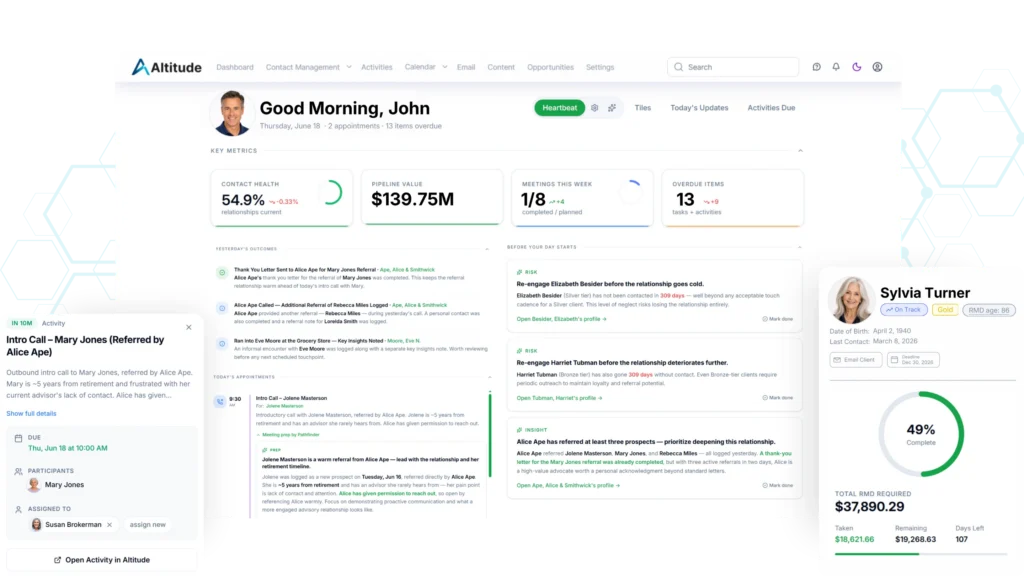
Altitude is built for that exact problem. It’s a CRM made for financial advisors, and it turns coaching direction into daily action. Your coach tells you to contact your top clients on a set schedule? Altitude tells you who’s due and helps draft the outreach. Your growth plan depends on clean follow-up with every prospect? The workflow engine keeps the steps from slipping through the cracks.
It also handles the parts of client life your coach keeps nagging you about, from money management conversations to a reminder about a client’s debt management goals or a fresh look at their budgeting. Pathfinder, the built-in AI assistant, can prep you for meetings and log the busywork, so your hours go to people instead of paperwork.
Coaching gives you the direction. Altitude helps you hold the line. Put the two together, and the plan on the whiteboard finally becomes the way you work.

FAQs about Financial Advisor Coaching
Bill Good Marketing is our number one pick, built on a proven, decades-old methodology that focuses on practice management rather than motivation. Other programs worth a look include Steve Sanduski and Carson Coaching. When you compare them, judge each on its track record, its methodology, and whether it helps you run the business instead of only managing money.
Yes, for advisors who actually run the plan. Coaching pays for itself when you execute on the direction you’re given. Sign up, skip the calls, and ignore the homework, and it’s just an expensive way to feel productive. The value was never in the advice by itself. It’s in what you do with it.
It depends on the format. Group coaching usually runs a few hundred dollars a month. One-on-one coaching for financial advisors costs more, often into the low thousands per month, because you’re paying for a plan built around your practice instead of a general one. Weigh that against what a single right-fit client is worth to your firm over ten years. The math tends to favor the coach.
Most advisors feel the difference within a few weeks and see it in the numbers within a few quarters. Time management and focus improve almost right away, since those are habit changes you control. Growth in assets under management takes longer, because building a pipeline and earning trust is a slow game. Coaching speeds that game up. It doesn’t skip it.