Ask the top financial advisors where their best new business comes from, and you’ll hear the same answer again and again. It isn’t cold calls. It isn’t ad spend. It’s referrals.
Schwab’s 2024 RIA Benchmarking Study found referrals from clients and centers of influence drove 67% of new clients and new client assets. And the richest source of referrals doesn’t come from clients alone.
It comes from a small group of well-placed professionals called centers of influence.
Centers of influence (COIs) have the highest ceiling of any referral source, but most advisors never reach it. They treat the relationship like a vending machine, put in a little effort, and wonder why nothing comes out. The advisors who do it right build something closer to a team. This post walks you through what a center of influence actually is, why it matters for your practice, and how to build relationships that send you clients for years.
What are Centers of Influence?
A center of influence (COI for short) is a non-competing professional who serves the same kind of clients you do, and who refers business back and forth with you. The key words are non-competing and back and forth. You aren’t fighting over the same work, and the goodwill flows both ways.
Think of it less like a sales lead and more like a teammate you share a roster with. Your clients already trust these people. They’ve already let them into their financial lives.
So who are they?
The usual list is full of the trusted advisors your clients already lean on. CPAs and accountants handle the books and the taxes. Attorneys, especially estate planning attorneys, handle the legal side. Insurance agents and insurance agencies cover the coverage you don’t write.
Realtors and real estate agents move clients into and out of property. The list goes beyond the obvious, too.
Funeral home directors sit at the center of a grieving family’s biggest decisions. Community leaders and local entrepreneurs often know everyone worth knowing in town. Any professional whose clients overlap with yours, and who isn’t after the same business, can be a center of influence.
Two Reasons Centers of Influence Matter for Financial Advisors
Before we get into the upside, one warning. If your main reason for chasing centers of influence is to get referrals, you’ll fail. That sounds backward, so stick with me. The advisors who treat COIs as a referral grab come across as takers, and takers get nothing. The wealth management professionals who win lead with two other reasons. Better service for their clients, and a bigger team behind their practice. The referrals follow on their own.
Here’s why both reasons pay off.
1. Business Growth for You
Cold-market prospecting is a grind. You market, you pitch, you hope. A referral from a center of influence is the opposite. The client shows up already warm, because someone they trust pointed them your way. You skip the part where you have to prove you’re not a scam.
That’s why COIs carry the highest ceiling of any referral source. One strong relationship can feed you qualified clients for years. A handful of them can change your whole book. This is also where a real COI strategy beats luck.
Instead of asking “where’s my next client coming from,” you build a system that answers the question for you. Steady referral sources turn business growth from a scramble into a routine, and they open business opportunities you’d never reach knocking on doors.
Done well, this is one of the most bang-for-your-buck marketing efforts you can implement. Kitces Research found advisors generate an average of $3 in revenue for every $1 spent cultivating a COI relationship. Try getting that return from ad spend.
2. Quality of Life Growth for Your Clients
Now flip to the client’s side. Most affluent clients juggle a different professional for every piece of their financial life. One person for taxes. Another for the estate plan. Another for insurance. Another for the house. The problem is that none of those people talk to each other. Mistakes slip through the cracks because nobody has the full picture.
You can fix that. By building the right network, you become the quarterback of your client’s whole financial team. You run the investment strategy. Your COI handles the part you don’t. When your client has a tax question or an estate question, you don’t shrug. You point them to the right person on the team, whether that person works down the hall or across town.
That simpler experience is your real value proposition, and it’s a genuine win-win. Your client’s financial life gets easier. The same client experience flows back through your partner to their clients. Everybody serves better, and happier clients on both sides naturally send more referrals. Nobody had to “sell” a thing.
What should you get out of a COI relationship?
Referrals. Lots of them. But, and this is the whole trick, you get them by not chasing them.
So how do you know if a relationship is real? Watch the flow.
A true center of influence sends you business, and you send them business right back. A useful benchmark from years of doing this is at least one to two solid referrals from each partner.
If the numbers are way off, you might have what’s known as a one-way street. That’s a partner who happily takes your referrals and never sends any back. Some people are just absent-minded. Others are quietly selfish. Either way, a one-way street isn’t a partnership, and it’s the single most common way these relationships fail.
The goal isn’t to collect business cards. It’s to build a small set of dependable referral sources who are almost as invested in your success as you are. That only happens when you put their business first.
6 Steps to Build and Maintain Relationships with Centers of Influence(COIs)
Here’s the part most advisors skip. A real COI strategy has a shape to it. You don’t just shake a few hands and wait. You work a process. Here’s the short version of one that works.
1. Find the right people
Start with the professionals your clients already use. Ask your clients about their CPA, their attorney, their insurance agent. Don’t beg for an introduction, just gather names. Then log everything in your CRM so you can see at a glance which professionals share the most clients with you. Those overlaps are your best first targets.
2. Take them to lunch
Once you spot a good candidate, invite them out. Your treat. The point isn’t to pitch yourself. Walk in with a “how can I help you” mindset, not a “how can you help me” one. Talk about the clients you share and how you can serve them better together. Bring something tangible that shows what your team does, so they leave with a clear sense of your value proposition.
3. Qualify them honestly
During that first meeting, pay attention to one thing above all. Do they ask about your business? If they never show any curiosity about what you do, that’s a red flag. It usually means they’re picturing a one-way street, not a partnership.
4. Make it official
Set a second meeting to agree on how you’ll work together. Lay out a few ground rules. Meet about once a quarter. Tell each other when a referral comes in. And never hand a partner’s client off to one of their competitors.
5. Engage every single month
This is where good intentions go to die, so be deliberate. Refer business to your partner first, before you expect anything back. Invite them to sit in on client reviews when it fits. Host a joint client event for both of your client bases. Send a handwritten thank-you note every time you get a lead from a COI. The more you stay in their world, the more they think of you in theirs. That consistency is your real referral strategy.
6. Check-in once a year
Even with the best effort, some partnerships fizzle. So once a year, run the numbers and ask the gut-check question that cuts through everything: “Would I trust my most valued client with this person?” If the answer is no, or even “I’m not sure,” it’s time to step back. No referral is worth risking a client relationship you’ve spent years building.
If all of this sounds like a lot to track, it is. That’s exactly the kind of practice management work a CRM should carry for you.
How Altitude CRM helps with Tracking Centers of Influence
Everything above is a process, and processes live or die by whether you actually follow them. That’s where a CRM built for this kind of work matters. Altitude is the CRM made for financial advisors, and it was designed to treat centers of influence like the relationships they are, not like names in a spreadsheet you’ll get to someday.
Find your people without digging
Start with finding your people. Altitude lets you store a contact as a professional and map that relationship right onto your client records. It comes with around sixty relationship types out of the box, including attorney, CPA, and business partner, so you can tag a client’s accountant or estate planning attorney and then see, in one view, exactly which professionals you share clients with. Those overlaps are your warmest COI prospects. Now they’re sitting right in front of you instead of buried in your memory.
Set the meeting and show up ready
Then there’s the lunch. Altitude CRM’s online booking tool hands your prospect a link to grab a time on your calendar, so you skip the back-and-forth emails. Before you walk in, Meeting Intelligence pulls together a prep summary and a suggested agenda, so you show up knowing exactly which shared clients you want to talk about. After the meeting, it drafts your follow-up and your action items for you. You leave the restaurant, and the next steps are already written.
Stay in touch without dropping the ball
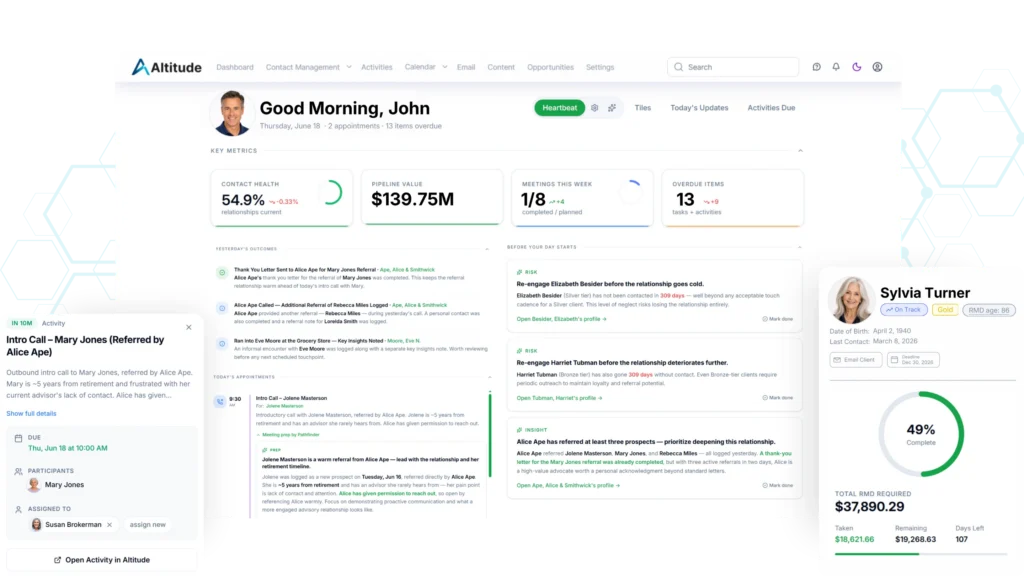
Now the hard part. Staying in touch every month without dropping the ball is what sinks most COI relationships, and it’s where Altitude CRM does its quietest, most useful work. The Personal Contact system lets you assign each center of influence a touch schedule, say once a quarter, then builds you a running list of who’s due this week, who’s due this month, and who you’ve let slip past due. Logging a touch creates an activity on its own, so the record keeps itself.
Make the small courtesies automatic
The small courtesies that keep you top of mind get easier too. The birthday-letter wizard and the letter templates handle the birthday cards and the thank-you notes you want to send the moment a referral lands. Task Actions can fire those off automatically when you check a box. You can even build the whole six-step process into an activity template, so onboarding a new center of influence runs the same proven way every time. New staff inherit that process without having to be taught it.
Know who’s actually worth keeping
When it’s time for your yearly check, Altitude does the counting. The opportunities pipeline tracks where your business comes from, with source tracking on every deal, so you can see at a glance which partners are really sending referrals and which ones have quietly turned into one-way streets. And every morning, Heartbeat, the daily AI briefing, surfaces your cooling contacts: the people, clients and COIs alike, who are going quiet and need a nudge before they drift away for good.
Let Pathfinder AI handle the busywork
Pathfinder ties it all together. It’s the AI assistant living inside Altitude, and you talk to it like a person. Ask it to draft the thank-you note, log the referral you just got, add the relationship between a client and their CPA, or tell you who you haven’t called this quarter, and it does it. The busywork that usually buries a good COI strategy turns into a sentence.
Start this week
Here’s the honest truth. None of this is complicated. It’s just relentless, and being relentless by hand is exactly where most advisors give up. So pick one professional your clients already trust. Set the lunch this week. Let Altitude carry the follow-through. One strong center of influence can change a year. A handful can change your practice. The software just makes sure not one of them ever falls off your radar.

Frequently Asked Questions about Centers of Influence (COIs)
A center of influence is a non-competing professional who serves the same clients you do and refers business back and forth with you. For financial advisors, common examples are CPAs, attorneys, insurance agents, and realtors. The relationship only works when referrals flow both ways, not just from you to them.
Any trusted professional whose clients overlap with yours and who isn’t competing for the same work. The usual list includes accountants and CPAs, estate planning attorneys, insurance agents, and real estate agents. Less obvious centers of influence include funeral home directors, community leaders, and local entrepreneurs who sit at the center of a network.
You earn them by serving first, not asking first. Refer business to your COI before you expect anything in return, invite them to sit in on client reviews, and stay in regular contact. A genuine partner sends you at least one to two referrals over time, and the business flows in both directions.
About once a quarter is a solid baseline, plus a thank-you note every time a referral comes in. Steady contact keeps you top of mind so your partner thinks of you when a client needs an advisor. A financial advisor CRM like Altitude can put each COI on a touch schedule and tell you who’s due, so the follow-up never slips.